Rent this space! For information, call (707) 585-2569 or e-mail.
For rates, click here.
For other news, see the
Western
Newsbeat.
11 West Coast-Bred Horses in the Breeders' Cup
Eleven horses bred in West Coast states have
drawn post positions for this weekend's Breeders' Cup World Championships
at Santa Anita.
Ten were bred in California, one in Washington.
Here they are (all are Grade 1 races):
$1,000,000 Juvenile Fillies Turf, 2-year-old fillies,
one mile on the
turf (Friday)
Saucey Evening, chestnut, by More Than
Ready--Jeweled Lady, by General Meeting. Breeder: Betty L. Mabee and Larry
Mabee (California). Owner: George Strawbridge, Jr. Trainer: Jonathan E.
Sheppard. Jockey: Garrett Gomez. Post position: 11. Odds: 9-2.
Atka, chestnut, by Swiss Yodeler--Artica,
by Frosty the Snowman. Breeders: Dr. Mikel C. Harrington and Patricia O.
Harrington (California). Owner: Mike Harrington Trustee. Trainer: Mike
Harrington. Jockey Russell Baze. Post position: 14. Odds: 30-1.
$1,000,000 Filly and Mare Sprint, 3-year-olds and up,
fillies and
mares, 7 furlongs
(Friday)
La Tee, bay, 4, by Broken Vow--Ashcreek,
by Stalwart. Breeder: Savario Farm (Washington). Owner: Allen and Susan
Branch. Trainer: Mark Glatt. Jockey: Jon Court. Post position: 14. Odds:
30-1.
Tiz Elemental, bay, 4, by Cee's izzy--Blending
Element (Ire), by Great Commotion. Breeder: Williamson Racing, LLC (California).
Owner: Warren B. Williamson. Trainer: Carla Gaines. Jockey: Victor Espinoza.
Post Position 8. Odds: 20-1.
$500,000 Marathon, 3-year-olds and up, 1 1/2 miles
(Saturday)
Add Heat, bay, 5, by Unusual Heat--Chemolo,
by Be a Native. Breeder: Madeline Auerbach (California). Owner: M. Auerbach,
LLC. Trainer: Barry Abrams. Jockey: Alex Solis. Post Position: 2. Odds:
20-1.
$1,000,000 Turf Sprint, 3-year-olds and up, about 6
1/2 furlongs
on the turf (Saturday)
California Flag, gray or roan, 4, by
Avenue of Flags--Ultrafleet, by Afleet. Breeder and owner: Hi Card Ranch
(California). Trainer: Brian J. Koriner. Jockey: Joe Talamo. Post position:
10. Odds: 15-1.
Idiot Proof, bay, 4, by Benchmark--Perfectly
Pretty, by Bertrando. Breeder: Mr. and Mrs. Martin J. Wygod (California).
Owner: Pam and Martin Wygod. Trainer: Clifford Sise, Jr. Jockey: Garrett
Gomez. Post position: 11. Odds: 8-1.
$2,000,000 Mile, 3-year-olds and up, one mile on the
turf
(Saturday)
Bold Chieftain, dark bay or brown,
5, by Chief Seattle--Hooked on Music, by Seattle Dancer. Bred by Ernest
L. Langbein, William Morey, Kenneth Robinson, and Dwaine Hall (California).
Owner: Hall or Langbein Trust or Robinson, et al. Trainer: William J. Morey,
Jr. Jockey: Russell Baze. Post position: 8. Odds: 15.1.
$2,000,000 Sprint, 3-year-olds and up, six furlongs
(Saturday)
Cost of Freedom, dark bay or brown,
5, by Cee's Tizzy--Freedom Dance, by Moscow Ballet. Breeder and owner:
Harris Farms Inc. (California). Trainer: Carla Gaines. Jockey: Tyler Baze.
Post position: 1. Odds: 4-1.
Two of the 11 were purchased at public auction,
Saucey Evening for $160,000 in the 2007 Keeneland September yearling sale
and La Tee for $50,000 in the 2005 Washington Thoroughbred Breeders Association
summer yearling sale.--October 22.
Schwarzenegger Reappoints Shapiro to CHRB
Governor Arnold Schwarzenegger reappointed
Richard Shapiro to the California Horse Racing Board Thursday. His action
renewed the service of the board chairman, whose term is expiring.
Here is the text of Schwarzenegger's announcement:
"Richard B. Shapiro, 55, of Hidden Hills,
has been appointed to the California Horse Racing Board. He has served
on the board since 2004. Since 1996, Shapiro has owned and served as president
of Winco Real Estate Services. From 1989 to 1996, he served as vice president
of Elins Development Company of Los Angeles and, from 1987 to 1989, Shapiro
was the executive vice president of EDM Equities. He was the president
of Western Harness Racing and served as executive vice president of Wincorp
from 1974 to 1984. This position requires Senate confirmation and there
is no salary. Shapiro is a Republican."--October 17.
Total of Mares Bred Down 7.7 Percent in 2008
The following is a press
release of The Jockey Club.
The Jockey Club today released Report of Mares
Bred (RMB) statistics for 2008 that show a continued decline in North American
Thoroughbred breeding activity.
Based on RMBs received through Oct. 10, 2008,
The Jockey Club reports that 2,643 stallions covered 52,410 mares in North
America during 2008.
The statistics include the number of mares
bred to each stallion and represent approximately 92 percent of the mares
that eventually will be reported as bred in 2008. The Jockey Club expects
to receive RMBs representing an additional 4,000 to 5,000 mares bred from
the 2008 breeding season, according to historical trends.
The number of stallions declined 5.9 percent
from the 2,808 reported at this time in 2007, while the number of mares
bred fell 7.7 percent from the 56,796 reported at this time last year.
"The 2008 RMB statistics indicate a further
reduction of Thoroughbred breeding activity across North America," said
Matt Iuliano, The Jockey Club's vice president of registration services.
"Stallions with a book size of less than 25 accounted for 78 percent of
the decline in the number of stallions and 30 percent of the drop in mares
bred."
Lion Heart led all stallions in 2008 with
214 mares bred, 20 more than Chapel Royal (194). Rounding out the top five
were Giant's Causeway (190), Hard Spun (181) and Street Cry (178).
Thoroughbred breeding activity in Kentucky
traditionally paces North America. During 2008, Kentucky's 318 reported
stallions covered 21,317 mares, or 40.7 percent of all of the mares reported
bred in North America. The number of mares bred to Kentucky stallions declined
1.9 percent against the 21,724 reported at this time last year.
Of the top 10 states and provinces by number
of mares reported bred in 2008 through Oct. 10, 2008, only Ontario and
Pennsylvania stallions covered more mares in 2008 than in 2007, as reported
at this time last year. The top 10 states and provinces, ranked by number
of mares reported bred through Oct. 10, 2008, are:
| State |
2007
Stallions
|
2008
Stallions
|
Change
|
2007
Mares Bred
|
2008
Mares Bred
|
Change
|
| Kentucky |
333
|
318
|
-4.5%
|
21,724
|
21,317
|
-1.9%
|
| Florida |
211
|
202
|
-4.3%
|
6,376
|
5,316
|
-16.6%
|
| California |
255
|
233
|
-8.6%
|
4,447
|
3,817
|
-14.2%
|
| Louisiana |
238
|
230
|
-3.4%
|
3,780
|
3,515
|
-7.0%
|
| New York |
92
|
85
|
-7.6%
|
1,967
|
1,329
|
-6.5%
|
| Texas |
205
|
191
|
-6.7%
|
1,935
|
1,722
|
-11.0%
|
| New Mexico |
137
|
128
|
-6.6%
|
1,775
|
1,456
|
-18.0%
|
| Oklahoma |
120
|
126
|
+5.0%
|
1,381
|
1,335
|
-3.3%
|
| Ontario |
66
|
77
|
+16.7%
|
1,257
|
1,272
|
+1.2%
|
| Pennsylvania |
72
|
89
|
+223.6%
|
941
|
1,237
|
+31.5%
|
|
Totals
|
1,729
|
1,679
|
-2.9%
|
45,583
|
42,826
|
-6.0%
|
RMB statistics for all reported stallions in
2008 are available through the Publications & Resources section of
The Jockey Club's website at http://www.jockeyclub.com.
The Jockey Club, founded in 1894 and dedicated
to the improvement of Thoroughbred breeding and racing, is the breed registry
for North American Thoroughbreds. In fulfillment of its mission, The Jockey
Club provides support and leadership on a wide range of important industry
initiatives, while its affiliated companies serve the information and technology
needs of owners, breeders, media, fans and farms, among others.--October
16.
Final Barretts Mixed Sale Deadline Is Friday
The following is a Barretts
Equine Ltd. press release.
The deadline for supplemental entries to the 2008
Barretts October Mixed Sale is Friday. Entries must be received by
Barretts by this date in order to be considered for this auction.
Due to stabling limitations, supplemental
entries will be screened prior to acceptance.
The entry form is available
online.
This auction of 514 head will be held on Monday,
October 27 and Tuesday, October 28, in the Hinds Pavilion located on the
grounds of Fairplex Park, beginning each day at 11 a.m. The
main catalog can be viewed by clicking
here.
For further information, please contact: Barretts
Equine Limited. Phone: (800) 467-7379; fax (909) 629-2155, or e-mail.--October
16.
TOC to Offer Conformation Clinic at Fresno
The following was adapted
from a Thoroughbred Owners of California press release.
A free "Conformation Clinic" will be offered by
Thoroughbred Owners of California on Saturday, October 11, at 11 a.m. in
the saddling paddock at the Big Fresno Fair.
The workshop will be conducted by track announcer
Frank Mirahmadi and trainer John Martin, who will be joined by a special
guest, prominent California owner-breeder John Harris.
The format will feature real racehorses being
brought into the paddock so that participants can get a close-up look at
conformation and how its various elements relate to soundness and racing
performance. A question-and-answer period will follow the demonstration.
Althoughthe clinic is free and open to the
public, reservations are recommended and can be made by calling TOC at
(800) 994-9909 or connectingonline at www.toconline.com.
The Big Fresno Fair is located at 1121 S. Chance Avenue, Fresno.--October
9.
Breeders' Cup Runners to Get Pre-Race Test
The following is a California
Horse Racing Board press release.
In an effort to insure the highest possible level
of integrity for the world championship events, the California Horse Racing
Board in conjunction with the Breeders' Cup will conduct out-of-competition
testing of horses pre-entered October 14 in the races to be run October
24-25 during the Oak Tree meet at Santa Anita Park.
Horses will be selected randomly for testing
from the pre-entry lists. The testing will specifically target epoetin,
darbepoetin, and other blood-doping agents, which typically are administered
days or weeks before competition and are not usually detectable in traditional
drug-testing of samples collected shortly after the race.
The Breeders' Cup is assisting the CHRB with
the collection of samples from pre-entered horses prior to their arrival
to California.--October 7.
Governor Signs Bill Changing Cal-Bred Law
The following is a California
Thoroughbred Breeders Association press release.
Governor
Arnold Schwarzenegger has signed into law Assembly Bill 3073, which allows
racing secretaries to include California-conceived horses in races previously
restricted to California-foaled horses.
"This bill, supported by the California Thoroughbred
Breeders Association and the Thoroughbred Owners of California, will assist
in increasing the inventory to fill California-bred races, provide added
incentive to breed to a California stallion and provide a safer means of
shipping horses both from and back to California for breeding purposes,"
said Doug Burge, CTBA executive vice-president and general manager. "Now
the new-born foal will not be subjected to shipping across country with
the mare, as it can be born at the destination of the next breeding."
The bill was authored by the Committee
on Government Organization. These registered California-sired horses will
only have entry in California-bred races and not be eligible for breeder
or owner awards. Current law provides for California-sired horse's
eligibility for stallion awards and that will remain the same.
Definition of a Cal Bred:
"The horse was dropped by a mare in California
after being conceived in California, or the horse was dropped by a mare
in California and the mare remained in California to be next bred to a
Thoroughbred stallion standing in California. (If the mare cannot be bred
for two successive breeding seasons but remains in California during that
period, her foal is considered to be a California-bred Thoroughbred.)"--October
1.
Barretts March Nomination Form Now Online
The following is a Barretts
Equine Ltd. press release.
The nomination form for the 2009 Barretts March
Selected 2-Year-Olds in Training Sale, scheduled to be hold on Tuesday,
March 10, in the Hinds Pavilion located on the grounds of Fairplex Park,
is now available by clicking
here.
The deadline for nomination is October 20.
Horses will be screened on pedigree prior to inspection. There is no fee
to nominate.
The online entry system for the 2009 March
Sale has also been activated. If you wish to open an account to nominate
your horses online without the hassle of manually filling out the form,
please e-mail your request to info@barretts.com
The online entry system can be found by clicking
here.
For further information, please contact: Barretts
Equine Limited. Phone: (800) 467-7379; fax (909) 629-2155, or e-mail.--September
24.
TOC Slates Northern Meeting for October 4
The following is a Thoroughbred
Owners of California press release.
TOC will conduct its Northern California annual
meeting on Saturday, October 4, at 10:30 a.m. at Golden Gate Fields. A
new format this year will combine a luncheon, business meeting, and handicapping
contest in one location - the newly refurbished Bay View Room.
Following the business meeting, the TOC Owners
Challenge - a members-only handicapping tournament - will get under way.
TOC members may participate at no charge, with the top finisher receiving
a sponsored entry as part of "Team TOC" in the 2009 Daily Racing Form/NTRA
National Handicapping Championship in Las Vegas.
Participation in the tournament is limited
to 200 TOC members, and pre-registration is strongly recommended. A second
handicapping tournament will be held in Southern California - at Hollywood
Park on Saturday, Nov. 22 - at which two additional players will earn a
spot on "Team TOC."
The inaugural Owners Challenge in 2007, held
in conjunction with TOC's annual meeting at Del Mar, attracted 91 participants.
Last year's top three finishers - Wayne Davis, Alan Mindell, and Gene Duguay
- went on to compete in Las Vegas in January, 2008.
This year's Northern California annual meeting,
which is the third annual, is expected to be well attended by local owners
and owner-trainers who were unable to attend the Southern California version.
More than 150 people attended TOC's annual meeting at Del Mar Racetrack
on Saturday, Aug. 16.
Complete details for both the annual meeting
and Owners Challenge handicapping tournament are available by calling (800)
994-9909 or visiting www.toconline.com.--September
23.
Claiming Exemption Rule in Effect on Saturday
The following is a California
Horse Racing Board press release.
A new rule goes into effect Saturday in California
allowing horses returning from layoffs of at least six months to be entered
in claiming races in which they will be ineligible to be claimed, just
one time, in an effort to encourage owners to give horses needed time off.
As originally proposed by the Thoroughbred
Owners of California, to be eligible for the non-claiming option the horse
must be entered at a claiming level equal to or greater than the price
for which it last started and must be returning from a layoff of at least
180 days.
"We would like to have horses have the opportunity
to be rested, lengthening their career," said TOC Director Tom Bachman
in testimony before the board. "It is to the owner's advantage to be able
to bring that horse back and run one time (and) not have to worry about
somebody claiming the horse and taking advantage of the time and money
spent in the rehab of the horse. It's as simple as that."
CHRB Chairman Richard B. Shapiro endorsed
the concept and commented, "We're trying to find a way to give the owner
an incentive to put a horse out for some R&R. The owner's made an investment
in rehabilitating the horse and he doesn't want to see that first time
back he loses the horse and the investment."
Vice Chairman John Harris commented that stopping
on a horse, giving the horse ample time to recover from an injury, and
then getting the horse back into racing can easily cost several thousand
dollars. "Allowing a horse to run at the price it last ran may better encourage
horses being returned to racing," he explained. "It is good for all concerned.
Longer term, I think we can do even more to encourage this area of good
equine management."
The board conducted a public hearing and adopted
this rule in May. The rule then passed review by the Office of Administrative
Law and was filed with the Secretary of State, effective September 20,
2008.
Horses entered for the non-claiming option
will be identified in the official program, and Equibase is taking steps
to identify horses running for this condition in their past-performance
lines beginning next month.--September 16.
Barretts #222 Will Sell to Benefit Tranquility
The following is a Tranquility
Farm press release.
Tranquility Farm is pleased to announce a very
special offering in the October Barretts Mixed Sale. Thanks to the generosity
of breeders Larry and Sheila Ullmann, 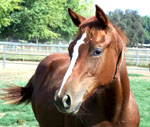 Shui
Mandate ( Hip
#222), a weanling filly by Perfect Mandate out of Feng Shiu, will sell
as a benefit for the 100 horses in retirement or awaiting adoption at Tranquility
Farm. Shui
Mandate ( Hip
#222), a weanling filly by Perfect Mandate out of Feng Shiu, will sell
as a benefit for the 100 horses in retirement or awaiting adoption at Tranquility
Farm.
Shui Mandate (see photo) is a half-sister
to multiple stakes winner Wind Water, who is still competing at stakes
level at age 6, with earnings of $664,500.
Tranquility Farm thanks Old English Rancho
for their generous contribution of sales prep for Shui Mandate; Sam Hendricks
and Barretts Sales for contributing their commissions; and Clarence Belvoir
for providing transportation.--September 15.
Barretts October Mixed Sale Catalog Now Online
The following is a Barretts
Equine Ltd. press release.
The catalog for the Barretts October Mixed Sale
is now online and will be mailed soon.
This auction of 514 head will be held on Monday,
October 27, and Tuesday, October 28, in the Hinds Pavilion located on the
grounds of Fairplex Park, beginning each day at 11 a.m.
The catalog can be viewed now by clicking
here.
Live interactive bidding on the sale will
be available to registered bidders. For more information regarding the
requirements for registering to bid interactively, click
here.
For further information, please contact: Barretts
Equine Limited. Phone: (800) 467-7379; fax (909) 629-2155, or e-mail.--September
12.
Western Foal Crops Show Decline in 2008
Foal crops in western states are continuing
to shrink.
The Jockey Club announced almost-complete
totals for the 2008 foal crop today, showing a decline in the number of
registered foals in every western state but one--Nevada, whose 2007 crop
of seven foals remained the same.
Although The Jockey Club estimated that the
count of registrations was only about 90 percent complete, late registrations
in western states historically have been below five percent.
Rocky Mountain states suffered the most, with
even New Mexico losing 8.6 percent, in spite of the opening of casinos
at several racetracks,
On the Pacific Coast, Washington was hit hardest,
dropping 18.8 percent. Oregon lost 10 percent and California 4.1 percent.
The Jockey Club pointed out that the numbers
are for the number of foals born in each state, not where they were conceived.
Here are the numbers for the nine western
states, followed by those of others with more than 1,000 mares bred in
2007, with late registrations still to come:
|
State
|
Mares Bred
2007
|
Live Foals
2007
|
Live Foals
2008
|
Foal Crop
% Change
|
| Arizona |
497
|
284
|
268
|
-5.6
|
| California |
4,723
|
3,131
|
3,004
|
-4.1
|
| Colorado |
311
|
152
|
108
|
-28.9
|
| Idaho |
253
|
100
|
69
|
-31.0
|
| New Mexico |
1,952
|
997
|
911
|
-8.6
|
| Nevada |
24
|
7
|
7
|
0
|
| Oregon |
371
|
221
|
199
|
-10.0
|
| Washington |
906
|
496
|
403
|
-18.8
|
| Wyoming |
7
|
7
|
2
|
-71.4
|
| |
|
|
|
|
| Kentucky |
21,938
|
14,801
|
15,040
|
+1.6
|
| Florida |
6,489
|
4,063
|
3,593
|
-11.6
|
| Louisiana |
4,217
|
2,016
|
2,009
|
-0.3
|
| New York |
2,067
|
1,316
|
1,0908
|
-16.6
|
| Texas |
2,290
|
1,213
|
1,055
|
-13.0
|
| Maryland |
1,439
|
966
|
811
|
-16.0
|
| Ontario |
1,455
|
783
|
768
|
-1.9
|
| Oklahoma |
1,684
|
601
|
704
|
+17.1
|
| Pennsylvania |
1,148
|
550
|
533
|
-3.1
|
| |
|
|
|
|
The Jockey Club announcement read, in part, as
follows:
"The Jockey Club today reported that 3,638
stallions covered 61,262 mares in North America during 2007, according
to statistics compiled through Sept. 4, 2008. These matings have resulted
in 34,561 live foals of 2008 being reported to The Jockey Club on Live
Foal Reports received as of Sept. 4, 2008.
"As in past years, The Jockey Club estimates
that the reporting of live foals, at this point in time, is approximately
90 percent complete. The reporting of live foals of 2008 is down 4.8% from
last year at this time when The Jockey Club had received reports for 36,317
live foals of 2007.
"'The decline in live foals of 2008 reported
to date corresponds to the decline in mares bred during 2007,' said Matt
Iuliano, The Jockey Club's vice president of registration services. 'These
factors led us to revise our registered foal crop projection for 2008 downward
by 900 foals to 36,600.'
"In addition to the 34,561 live foals of 2008
reported through Sept. 4, The Jockey Club had also received 7,199 No Foal
Reports for the 2008 foaling season.
"The number of stallions declined 6.3 percent
from the 3,881 reported for 2006 at this time last year, while the number
of mares bred decreased 3.7 percent from the 63,629 reported for 2006.
"The 2007 breeding statistics are available
alphabetically by stallion name through the Publications and Resources
link on The Jockey Club home page."--September
11.
Barretts Cancels Classic I Sale--Too Few Entries
The following is a Barretts
Equine Ltd. press release.
Officials at Barretts Equine Limited have announced
that it's Classic I Sale of horses of racing age scheduled for the day
after this year's Breeders Cup has been cancelled because of insufficient
entries.
"We found that California's racing stables
primarily want to be buyers, not sellers, in that kind of market," stated
Barretts' President, Jerry McMahon, adding that "prohibitive transportation
costs kept us from attracting quality horses from out of the area."
McMahon also said that the company has not
made any decision regarding subsequent sales of this kind.
For further information, please contact: Barretts
Equine Limited. Phone: (800) 467-7379; fax (909) 629-2155, or e-mail.--September
10.
Barretts Fall Yearling Photographs Now Online
The following is a Barretts
Equine Ltd. press release.
Submitted photographs of yearlings in the 2008
Barretts Fall Selected Yearling Sale catalog, co-sponsored by the California
Thoroughbred Breeders Association, are now online and can be viewed by
clicking
here.
This auction of 235 head will be held on Tuesday,
September 30, in the Hinds Pavilion located on the grounds of Fairplex
Park, beginning at 11 a.m.
Among the stallions represented in the sale
catalog are Benchmark, Bertrando, Bring the Heat, Chapel Royal, Dixie Union,
E Dubai, El Corredor, Grand Reward, Harlan's Holiday, Holy Bull, Include,
Indian Charlie, In Excess, Johannesburg, Macho Uno, Medaglia d'Oro, Mizzen
Mast, Orientate, Proud Citizen, Roman Ruler, Sky Mesa, Speightstown, Stormy
Atlantic, Toccet, Tribal Rule, Trippi, Two Punch and Unusual Heat.
Live interactive bidding on the Fall Yearling
Sale will be available to registered bidders. For more information regarding
the requirements for registering to bid interactively, click
here.
For further information, please contact: Barretts
Equine Limited. Phone: (800) 467-7379; fax (909) 629-2155, or e-mail.--September
8.
The Jockey Club Adds Three New Californians
The following is adapted
from a press release of The Jockey Club.
The Jockey Club today announced the election of
four new members, three of them Californians: Dr. Rick Arthur, B. Wayne
Hughes, Warren "Spud" Williamson and Peter Willmott.
Dr. Arthur is the equine medical director
for both the California Horse Racing Board and the School of Veterinary
Medicine at the University of California, Davis. A member of the board
of directors of Oak Tree Racing Association and Grayson-Jockey Club Research
Foundation, Arthur is active in national medication and drug testing issues
and serves as secretary of the Racing Medication and Testing Consortium.
Hughes is the co-founder and chairman of Public
Storage, the nation's largest self-storage company. He owns Spendthrift
Farm in Lexington, Ky., and serves on the board of directors of Breeders'
Cup Ltd. He breeds and races under his own name.
Williamson is chairman of the Chandler Trusts
and the former chairman and CEO of Chandis Securities Co. He serves on
the board of directors of Oak Tree Racing Association. He breeds under
Williamson Racing LLC and races under his own name.
Willmott is president of Willmott Services
Inc., a retail holding and consulting company. He is treasurer of TOBA,
and serves on the organization's board of trustees and as chairman of TOBA's
American Graded Stakes Committee. He breeds and races under the Willmott
Stables banner.
The Jockey Club, founded in 1894 and dedicated
to the improvement of Thoroughbred breeding and racing, is the breed registry
for North American Thoroughbreds. The Jockey Club fulfills that longstanding
commitment by serving the industry through its family of companies and
by providing support and leadership on a wide range of important industry
initiatives.--September 4.
CARMA Event Raises More Than $100,000
The following is a Thoroughbred
Owners of California press release.
At its first public event, CARMA (California Retirement
Management Account) raised more than $100,000 for retired racehorses, launching
the new non-profit's 2008 fundraising campaign. A festive evening, held
at the Del Mar Hilton on Aug. 21, was enjoyed by more than 300 owners,
trainers, jockeys and fans and included a silent auction and charity poker
tournament.
The Texas Hold 'em style poker tournament
was won by Dennis Yokum, racing manager for Mercedes Stable. Other top
finishers included owner Bob Bone, trainer Peter Eurton, and Del Mar executive,
Craig Dado. More than 200 players took part in the tournament, which raised
$50,000.
The silent auction, which alone raised more
than $65,000, included unique items such as Kobe Bryant and Derrick Fischer
autographed Lakers basketballs, an oil painting that originally hung in
the Bay Meadows Turf Club, and several stallion seasons with live foal
guarantees to such popular California sires as Bertrando, Event of the
Year and Unusual Heat. A signed and framed Erica Nordean print, "Women
in Racing," a very popular and hotly contested item, went for $635.
CARMA Chair Madeline Auerbach acknowledged
the vital role of the many dedicated volunteers. "So many people donated
items for the auction, and we had more than a dozen people assisting throughout
the day and evening," said Auerbach. "They were instrumental in making
the evening a success, and CARMA can't thank them enough."
All CARMA donations will be used to help care
for retired racehorses whose careers have ended after competing in California
Thoroughbred races. Through a detailed grant process, facilities that care
for such Thoroughbreds may apply for funding on an annual basis.
CARMA's first grants will be awarded in January 2009.
CARMA is run by an independent board of directors
and is responsible for hosting fundraising events, educating owners and
trainers on equine retirement and working to unify the industry in support
of our equine athletes. Visit CARMA's website at www.carma4horses.org.
A 501(c )(3) non-profit charity, CARMA is actively seeking contributions.
Donations are tax deductable and may be sent to: CARMA, PO Box 1086,
Sierra Madre, CA 91025-9086. (Tax ID #80-0146395).--September 3.
Washington Yearling Average Declines 25.8%
The following was adapted
from a Washington Thoroughbred Breeders Association press release.
Numbers were down in all categories at the Washington
Thoroughbred Breeders Association's Summer Yearling sale Tuesday at Emerald
Downs.
Of the 215 yearlings consigned, 199 went through
the sales ring with 114 selling for a $1,279,500 total and an $11,224 average,
a 25.8 percent drop from 2007 sale figures. The sale median was $6,500,
down 45.8 percent from the 2007 $12,000 median.
As with most of the nation's sales, RNAs (those
runners whose reserves were not attained) jumped dramatically, with the
Washington sale attaining 42.7 percent buybacks, an all-time high. These
first numbers are preliminary, and are subject to change.
Topping this year's sale was a filly sired
by sprint champion Cherokee Run who was purchased by David and Jill Heerensperger
for $92,000. The filly's full sister, 2-year-old Cherokee Echo - a 2007
WTBA sale graduate - had won the Barbara Shinpoch Stakes at Emerald Downs
just two days prior to the sale.
The Heerenspergers also purchased the fourth
highest offering, a filly by You and I out the young stakes-winning mare
Cascade Corona, which sold for $45,000. The filly was consigned by Mr.
and Mrs. Frederick L. Pabst, who also bred Cascade Corona's graded stakes-placed
half-brother, Son's Corona, who raced for the Heerenspergers.
El Dorado Farms LLC consigned the second and
third highest selling yearlings. Mark Dedomenico LLC of Redmond went to
$50,000 to acquire a City Zip filly out of Stormbow, a stakes-producing
daughter of the great sire Storm Cat, from their consignment.
Enumclaw-based El Dorado also sold a half-brother
to $220,000 stakes winner Indian Weaver, who is from the final crop of
four-time leading Washington sire Slewdledo, for $47,000. The colt was
purchased by California trainer Jeff Bonde as agent.
The top-selling yearlings of the sale were:
Hip 38 F. Cherokee Run-Silver Echo,
$92,000. Consigned by Northwest Farms LLC, Agent. Purchased by Dave and
Jill Heerensperger, Bellevue, WA.
Hip 52 F. City Zip-Stormbow, $50,000.
Consigned by El Dorado Farms LLC (Ron & Nina Hagen). Purchased by Mark
Dedomenico LLC, Redmond, WA.
Hip 154 C. Slewdledo-Go for Jackie,
$47,000. Consigned by El Dorado Farms LLC (Ron & Nina Hagen). Purchased
by Jeff Bonde, Agent, Pleasanton, CA
Hip 115 F. You and I-Cascade Corona
$45,000. Consigned by Blue Ribbon Farm (M/M Frederick L. Pabst). Purchased
by Dave and Jill Heerensperger, Bellevue, WA.
Hip 30 C. Hold That Tiger-Sandra
Smiles, $40,000. Consigned by Halvorson Bloodstock Services LLC, Agent.
Purchased by Jeff Bonde, Pleasanton, CA
Hip 172 C. Newfoundland-Katherine Jean,
$38,000. Consigned by Griffin Place LLC, Agent. Purchased by John Maryanski,
Auburn, WA
Hip 182 F. Gold Case-Late Nite Martini,
$38,000. Consigned by Griffin Place LLC. Purchased by Ron Crockett, Inc.--September
2.
Sought After Moves to Rancho San Miguel
Sought After,
whose current 2-year-old crop includes a Del Mar stakes horse and a Golden
Gate Fields track-record setter, will stand in 2009 at Rancho San Miguel,
San Miguel.
The 8-year-old son of Seeking the Gold stood
in 2008 at Daehling Ranch, Elk Grove.
Sought After is the sire of six winners and
earners of more than $200,000, including two stakes horses, 3-year-old
Bean Who ($21,360, 3rd Gateway to Glory Stakes at Fairplex Park) and 2-year-old
Control Seeker ($49,940, 2nd Im Smokin Stakes at Del Mar).
Another juvenile, Cross Fire, set a new track
record for 4 1/2 furlongs at Golden Gate Fields in his first start.
Sought After is out of French Group 2 winner
Smolensk, by Danzig. She is a half-sister to Better Than Honour, dam of
champion 3-year-old filly Rags to Riches and Jazil, both winners of the
Belmont Stakes. The latter, also by Seeking the Gold, is a three-quarter
brother to Sought After.
Sought After's 2009 stud fee has not been
announced. He is the property of Miraleste Inc.--September 2.
Washington Summer Yearling Sale Tuesday
The following is a Washington
Thoroughbred Breeders Association press release.
The 42nd annual Washington Thoroughbred Breeders
Association Summer Yearling Sale will be held this coming, Tuesday, September
2, with 215 horses cataloged. The sale will get under way at 1 p.m. at
the Morris J. Alhadeff Sales Pavilion located at Emerald Downs in Auburn.
The sale features many top local and nationally
prominent sires. Among them are members of the final crop of Washington
sire-great Slewdledo, offspring of Cahill Road - the sire of back-to-back
Longacres Mile (G3) winners The Great Face and Wasserman - yearlings by
Washington freshman leader Private Gold.
National 2008 freshman sire leaders Chapel
Royal, Friends Lake, Cuvee and The Cliff's Edge are also represented. Other
national sires of note include Arch, Beau Genius, Cape Canaveral, Cee's
Tizzy, Cherokee Run, Cit Zip, Crafty Prospector, Deputy Commander, Five
Star Day, Golden Missile, Honour and Glory, In Excess (Ire), Lost Soldier,
Marquetry, Military, Monarchos, Orientate, Roar, Salt Lake, Sky Mesa, Steven
Got Even, Stormin Fever, Swiss Yodeler, Vicar and Yankee Gentleman.
Among the stallions with first crop opportunities
cataloged are Grand Reward, Limehouse, Midas Eyes and Offlee Wild.
From the sale that has brought forth the likes
of current stakes stars La Tee (multiple graded stakes-placed in Southern
California), unbeaten 2-year old stakes winners Dandy Dora and Ladyledue
and graded stakes stars such as Rings a Chime (G1), Tali'sluckybusride
(G1), Classy Cara (G2), Makors Mark (G2), The Great Face (G3), Hosco (G3).
For more information, go to www.washingtonthoroughbred.com,
where catalog pages and further information about the sale and the WTBA
can be found; or call (253) 288-7878.--August 29.
Barretts Classic I Entry Deadline a Week Away
The following is a Barretts
Equine Ltd. press release.
The final deadline for entry to the Barretts Classic
I Selected Horses of Racing Age Sale, to be conducted on Sunday, October
26, is next Friday, September 5. here for the entry
form.
Entries will be screened prior to acceptance
for this sale.
The Breeders Cup World Championships will
be conducted at nearby Santa Anita on the Friday and Saturday immediately
preceding this auction. You'll find additional information regarding this
sale by clicking
here.
For further information, please contact: Barretts
Equine Limited. Phone: (800) 467-7379; fax (909) 629-2155, or e-mail.--August
29.
CHRB Schedules Hearing on Safety Reins
The following is a California
Horse Racing Board press release.
The California Horse Racing Board will conduct
a public hearing September 18 to consider mandating the use of safety reins
at California racetracks in order to provide greater protection to riders.
The public is encouraged to submit written comments on this proposal by
September 8 and to attend the public hearing in Pomona.
On June 27, the Board approved for 45-day
public notice a proposed rule to require the use of safety reins in racing
and training in California. Safety reins contain an internal back-up cord
connected to the bit, so that if the traditional outer reins break, the
jockey or driver can still maintain control of the horse. Safety reins
are strongly endorsed by the Jockeys' Guild, which helped draft legislation
that became Section 19504 of the Horse Racing Law requiring the Board to
require the use of safety reins if the Board determines they would provide
jockeys and exercise riders greater protection from accidents and injuries
than conventional reins.
Testimony by representatives of the Jockeys'
Guild at that June 27 Board meeting focused on how traditional reins sometimes
break from continuous wear and from manufacturing defects, placing jockeys
at great risk, particularly when this occurs during a race. They demonstrated
how safety reins contain an internal cord that is either looped or clipped
to the bit, so if the outer reins break, the inner cord that is independently
attached to the bit helps the jockey keep control.
The California Thoroughbred Trainers asked
the Board to delay mandating safety reins until national standards are
developed through laboratory testing. The CTT was especially concerned
about determining the breaking strength of the inner cord, which they consider
a safety issue for horses.
The Board elected to place the proposed rule
out for public notice, and asked the various parties to submit additional
information addressing the breaking strength of safety reins.
Written comments should be sent by e-mail
to ColleenG@chrb.ca.gov or addressed to Colleen Germek, Regulation Analyst,
California Horse Racing Board, 1010 Hurley Way, Suite 300. Sacramento,
CA 95825. The time for the start of the September 18 meeting at Fairplex
Park will be posted on the CHRB website (www.chrb.ca.gov) at least 10 days
beforehand. An audio link to the meeting will be available on the CHRB
website.--August 28.
Northern California Sale Turns Down Sharply
Fears that the sagging national economy and
the weakness of the Thoroughbred industry would harm the CTBA's Northern
California yearling sale were realized Tuesday at the Sonoma County Fairgrounds
in Santa Rosa.
The average for the fifth renewal of the sale
fell 23.3 percent, from $5,838 to $4,535, and the median fell 37.5 percent,
from $4,000 to $2,500. The average was 44.6 percent below the average of
$8,192 recorded in 2006, the high-water mark since the sale's return to
Northern California in 2004.
The 2008 gross was 47.5 percent lower than
it was a year ago, $471,700 vs. $899,200. Only 55.6 percent of those that
entered the ring emerged as sold compared with 65 percent in 2007.
A $37,000 Salt
Lake filly consigned by Green Acres Stable, agent for Lercari Thoroughbreds,
was the sale's high-seller, purchased by Super Horse, Inc., of Newport
Beach. Bred by Betty and Larry Mabee, she was bought by the Lercaris for
$7,200 in last fall's Barretts mixed sale.
She was the second consecutive sale-topper
for Wilton breeders Fred and LeAnn Lercari, whose Siberian Summer colt
was the high-seller in 2007.
The second-highest price was $25,000 for a
Vronsky
colt bought by Sierra Sunset LLC from the Old English Rancho consignment.
He was bred by Old English Rancho and Berumen.
Two other yearlings sold for $20,000 each--a
colt
by Lost Soldier bred by John Crook and consigned by Green Acres bought
by Sierra Sunset LLC and a High
Brite filly bred and consigned by Harris Farms and purchased by Clay
Fritz and partners.
Last year, six yearlings sold for $20,000
or more. A further indication of the lower market was the count of yearlings
sold for $10,000 or more--25 in 2007 and only nine this year.
As expected, the bottom of the market was
hit hardest.
In 2007, 35 horses failed to draw the minimum
bid of $1,000. This year it was 45, with 36 of those coming in the final
two-thirds of the catalog as the sale lost steam after a promising start.
Another indication of the absence of buyers
at the bottom were the 99 whose final bid--including buybacks and no-bids--was
$2,000 or less, 52.9 percent of those that entered the ring. Last year,
that number was 90, 38 percent of those offered.
For complete sale results, click
here.--August 26.
CHRB Gets Even Tougher on Steroid Use
The following is a California
Horse Racing Board press release.
The California Horse Racing Board is stepping
up enforcement efforts to protect the wagering public with increased pre-race
and out-of-competition testing and by prohibiting horses from running for
30 days after they've been administered anabolic steroids, effective this
Friday, August 22.
"We mean business!" said an obviously angry
CHRB Chairman Richard B. Shapiro during Tuesday's meeting of the Medication
Committee following a report from the Board's equine medical director that
some trainers are continuing to administer anabolic steroids prior to the
penalties becoming far more severe on September 4.
"We will have no sympathy for any owners or
trainers who flaunt our rules," agreed Vice Chairman John Harris, who serves
on the Medication Committee with Chairman Shapiro.
None of the owners or trainers was identified
during the meeting.
The CHRB has been phasing in the new prohibition
of anabolic steroids in racing horses and the penalties for violations
in order to give horsemen fair notice and to allow sufficient time for
any previously administered anabolic steroids to completely leave the systems
of horses racing in California.
The process of adopting these new regulations
has been in the works for more than a year, and discussed at numerous public
meetings. On May 12, the CHRB issued an advisory informing all trainers
that testing for anabolic steroids would commence on July 1, and they were
advised to stop using those drugs. Any owner or trainer who had a horse
test above permitted levels for nandrolone, boldenone, stanozolol, or testosterone
during July was sent an unofficial notice of a potential Class 4 violation.
Those unofficial notices advised owners and trainers to review their medication
procedures and referred the licensees to previous CHRB anabolic steroids
advisories.
On August 1, the CHRB began official
enforcement of all regulations for nandrolone, boldenone, stanozolol, and
testosterone as written. This step was clearly announced in another CHRB
advisory/directive, which was widely reported by the news media. The final
phase comes September 4 when penalties will increase for reclassified (Class
3) nandrolone, boldenone, stanozolol, and testosterone, Violations will
result in the automatic forfeiture of purse money, and licensees will face
possible suspensions and fines.
Dr. Rick Arthur, the CHRB equine medical director,
reported Tuesday that from 418 tests for anabolic steroids performed in
July at Hollywood Park and Del Mar, 38 contained testosterone, nandrolone,
stanozolol, or boldenone in excess of authorized levels, and of those,
28 involved two trainers. Significantly, Dr. Arthur also reported that
in the last week, anabolic steroids were being administered within three
days of racing. He emphasized that with the exception of two trainers,
the compliance rate on the Southern California thoroughbred circuit is
97 percent.
"They're not naïve," said Chairman Shapiro,
who later added, "It's shameful that two or three people have taken an
abusive approach for personal gain at the expense of the rest of the industry."
He further noted that "97 percent of owners and trainers complied with
our rules, and they deserve praise, not to be disadvantaged by a few people
who chose to ignore the rules."
Historically, the analysis of blood and urine
samples has taken place days after the horses raced, but last year the
CHRB also began testing horses in training that were not yet entered to
run. Now the Board will be stepping up its use of out-of-competition testing
in order to stop violations and protect the public.
The CHRB maintains a list of sick and injured
horses, which is commonly known as "the vet's list." Horses on this list
are not eligible to compete in races, and they must demonstrate their complete
recovery before they can be taken off of the list.
Anabolic steroids are approved by the FDA
for use in sick or debilitated horses. State law requires a legitimate
medical purpose to prescribe anabolic steroids and further prohibits their
use for the purpose of enhancing athletic performance.
CHRB anabolic steroid regulations permit the
administration of anabolic steroids to sick horses to aid their recovery,
but anabolic steroids are not permitted for racing purposes. Therefore,
beginning August 22, any horse administered anabolic steroids will be placed
on the official CHRB Veterinarian's List for 30 days.
"During their recovery period, those horses
will not be allowed to race," said Chairman Shapiro. "This is reasonable
in all respects. It protects the horse, the other participants, and the
public.
"It is a shame," he added, "that apparently
a few owners and trainers are not in keeping with the spirit of the industry
and the public to abolish steroids."--August 21.
Tour of Seabiscuit's Home to Benefit GEVA
The following is a Seabiscuit
Heritage Foundation press release.
The general public is invited to tour Ridgewood Ranch to benefit GEVA,
a Northern California Thoroughbred retirement and rehabilitation foundation,
Saturday, October 11th. Friends, fans
and supporters of Seabiscuit are invited to tour Ridgewood Ranch, home
and final resting place of the horseracing legend in Willits, CA, on Saturday,
October 11, and to show their support for Glen Ellen Vocational Academy,
an equine retirement foundation operated by Pam Berg in nearby Sonoma County.
The event is sponsored by the Seabiscuit Heritage Foundation and Willits
Chamber of Commerce.
Berg and a handful of volunteers are rescuing
and providing care for injured and retired thoroughbreds so that they may
recover and return to riding soundness, just as Seabiscuit once did under
his trainer Tom Smith. Tom Smith's nephew James Watkins along with his
wife Lucy are both avid supporters of GEVA and help provide sponsorships
for individual retired horses. GEVA was founded to provide homes for injured,
retired, and abused horses, or horses just in need of a home.
Reservations must be made in advance at the
Willits Chamber of Commerce by calling 707-459-7910 or by visiting www.willits.org.
Representing the Seabiscuit Heritage Foundation
will be Jacqueline Cooper, owner and breeder of American Legend Horse Farm,
which is working to preserve the Seabiscuit bloodline at Ridgewood, and
president of the foundation.
Nestled in the oak and redwood-studded ranchlands
and mountains of Northern California, Ridgewood Ranch was where Seabiscuit
recovered after sustaining a suspensory ligament injury. His recuperation
set the stage for an electrifying blaze-of-glory career finish at Santa
Anita Park that captivated Depression-era America. Owner Charles Howard
was also one of the initial investors of Santa Anita Park in 1933.--August
21.
Tranquility Farm Reports Arizona Horses Saved
The following is a Tranquility
Farm press release.
Thanks to the tremendous outpouring of concern
and support from every corner of the Thoroughbred world, Tranquility Farm
has rescued and removed to safety 36 pregnant broodmares from a feedlot
in Phoenix, Arizona. We have also purchased the stallions Seattle Bound,
Major Moment, Mr. Bolg, and Lindsey's Roberto.
None of this would have been possible without
the invaluable assistance of The Blood-Horse, Thoroughbred Information
Agency, Alex Brown website, HRTV, and many others in the racing media who
kept this issue in the forefront of public attention and did a magnificent
job of updating the situation. Thanks to their faithful reporting horse
lovers everywhere have responded with financial aid and the offer of new
homes for these abandoned horses.
Our next website update will be a listing
of all the broodmares that are available for adoption, and a special "Thank
You" page to all of our generous supporters. It will take us a few days
to care for the mares and match them up with their papers, and your patience
is greatly appreciated while we deal with the needs of the horses.
New adopters please fill out the adoption
application on our website
and mark it "Broodmare." If you have already contacted Tranquility Farm
and are waiting for a broodmare you will be contacted personally by phone
or e mail after August 17.
Please remember that we still need your help
to care for the Warren mares until they are all adopted!--August 15.
For additional information,
click
here.
Barretts Classic Sale Early-Entry Deadline Near
The following is a Barretts
Equine Ltd. press release.
The deadline for early bird entry to the Barretts
Classic I Selected Horses of Racing Age Sale, to be conducted on Sunday,
October 26, is this Friday, August 15. Entries must be postmarked by thats
date in order to qualify for the reduced entry fee. Click
here for the entry form.
Entries will be screened prior to acceptance
for this sale. The final deadline for entries to this auction is Friday,
September 5.
The Breeders Cup World Championships will
be conducted at nearby Santa Anita on the Friday and Saturday immediately
preceding this auction. You can find additional information regarding this
sale by clicking
here.
For further information, please contact: Barretts
Equine Limited. Phone: (800) 467-7379; fax (909) 629-2155, or e-mail.--August
13.
California Fall Yearling Sale Catalog Now Online
The following is a Barretts
Equine Ltd. press release.
The catalog for the 2008 California's Fall Selected
Yearling Sale, co-sponsored by Barretts and the California Thoroughbred
Breeders Association, is now online and will be mailed soon.
This auction of 235 head will be held on Tuesday,
September 30, in the Hinds Pavilion located on the grounds of Fairplex
Park in Pomona, beginning at 11 a.m.
The catalog can be viewed now by clicking
here.
Submitted photographs of yearlings in the
sale catalog will be posted to the Barretts website soon after September
5.
Among the stallions represented in the sale
catalog are Belong to Me, Benchmark, Bertrando, Bring the Heat, Chapel
Royal, Cuvee, Dixie Union, E Dubai, El Corredor, Five Star Day, Grand Reward,
Harlan's Holiday, Holy Bull, Include, Indian Charlie, In Excess, Johannesburg,
Macho Uno, Marino Marini, Medaglia d'Oro, Mizzen Mast, Momentum, Old Topper,
Orientate, Pollard's Vision, Powerscourt, Proud Citizen, Pure Prize, Roar,
Roman Ruler, Sky Mesa, Speightstown, Stormy Atlantic, Swiss Yodeler, Taste
of Paradise, Toccet, Touch Gold, Tribal Rule, Trippi, Two Punch,
Unusual Heat, Van Nistelrooy and Yonaguska.
Live interactive bidding on the Fall Yearling
Sale will be available to registered bidders. For more information
regarding the requirements for registering to bid interactively, click
here.
For further information, please contact: Barretts
Equine Limited. Phone: (800) 467-7379; fax (909) 629-2155, or e-mail.--August
8.
Seabiscuit Double to Appear at State Fair
The following is a California
State Fair press release.
No doubt one of the greatest legends in American
racing history, Seabiscuit won the hearts of many during the Great Depression
and once again in 2003's critically-acclaimed film, "Seabiscuit."
The Kentucky-bred Fighting Furrari was a struggling
racehorse and with 16 starts and only one win, but a new career was in
his cards--Fighting Furrari is a dead ringer for the beloved Seabiscuit
and a star was born. He played the part of Seabiscuit in the film.
This year's fairgoers will get the chance
to meet the star thoroughbred that played Seabiscuit at the California
State Fair's Cavalcade of Horses from Aug. 15 through Labor Day!
Ridden by a jockey dressed in Seabiscuit's
original silks, the horse will make an appearance each day of the All Breeds
Race Meet.
Additionally, William H. Nichols, former caretaker
of the original Seabiscuit and author of Seabiscuit, the Rest
of the Story, will be greeting fair patrons and signing copies of his
book at the Cavalcade of Horses.--August 8.
CHRB Issues Advisory on Steroid Rules
The following is a California
Horse Racing Board advisory.
Date : August
7, 2008
To :
All Horsemen and Racing Officials
From : Kirk Breed
Executive Director
Subject : ANABOLIC STEROIDS ADVISORY
On July 17, the California Horse Racing Board
adopted a regulatory amendment moving stanozolol, boldenone, nandrolone,
and testosterone from Class 4 to Class 3 and from Category D to Category
B penalties. The California Office of Administrative Law now has completed
its review and given final State approval to that regulatory amendment.
The CHRB will begin enforcement of the amended
rule with races run September 4, 2008, and thereafter. Stanzolol, boldenone,
nandrolone, and testosterone will be Class 3 substances with Category B
penalties, and the presence of any of these anabolic steroids in the post-race
sample above the authorized levels of 1844 (e) (10-14) will result in the
automatic disqualification of the horse and redistribution of the purse.
Category B penalties call for a minimum 30-day suspension and a fine up
to $10,000.
Through September 3, 2008, stanozolol, boldenone,
nandrolone, and testosterone will remain Class 4 violations and Category
D penalties. All other anabolic steroids have been Class 2 or Class 3 violations
and Category B penalties since July 1, 2008.--July 7.
CHRB Sets Hearings on Two Rule Changes
The following is a California
Horse Racing Board press release.
The California Horse Racing Board will conduct
two public hearings August 19, one on a proposal to uncouple horses in
the wagering even if there is some ownership overlap, provided the horses
have different trainers, and the second on a regulatory amendment to allow
owners to renew their licenses even if they do not own a racehorse at the
time of renewal.
The Board proposes to amend Rule 1606 exempting
thoroughbred horses from the coupling requirement if the horses are owned
by different partnerships whose compositions are not mirror images, and
there is at least one partner with an ownership interest in each of the
partnerships, provided the horses have different trainers.
The uncoupling issue has been discussed at
numerous public meetings, and the recommendations range from leaving the
rule unchanged to eliminating coupling altogether. The racing commissioners
believe the issue should be addressed one step at a time, beginning with
this proposal to uncouple some horses even if there is some ownership overlap.
CHRB Vice Chairman John Harris said the change
should create more wagering interests in races and help address concerns
raised when one part of an entry is a late scratch, especially when the
scratched horse is the heavily favored part of the entry.
The Board proposes to amend Rule 1505 to provide
that an applicant for renewal of a horse owner license whose license is
in good standing with the Board may renew such license regardless of whether
the applicant currently owns a properly registered racehorse in the care
of a licensed trainer.
Vice Chairman Harris said the "idea is to
be more user-friendly.to keep owners in the game and not put up roadblocks
for them" by requiring an owner to have a horse at the time of renewal.
The Board solicits public input at the public
hearings and beforehand. Written comments, which must be received by August
4, should be sent by e-mail to harolda@chrb.ca.gov or addressed to Harold
Coburn, Regulation Analyst, California Horse Racing Board, 1010 Hurley
Way, Suite 300. Sacramento, CA 95825. The time for the start of the August
19 meeting in the simulcast facility at Del Mar will be posted on the CHRB
website (www.chrb.ca.gov) at least 10 days beforehand. An audio link to
the meeting will be available on the CHRB website.--August 1.
Speakers Listed for TOC's Del Mar Seminar
The following was provided
by Thoroughbred Owners of California.
The public is invited to learn the "ins and outs"
of racehorse ownership at a free seminar hosted by Thoroughbred Owners
of California (TOC) on Saturday, Aug. 2, in the Veranda Café at
Del Mar Racetrack. A panel of experienced horse owners will discuss everything
from choosing a trainer to costs of ownership, starting at 8:30 a.m.
On the same day, another TOC seminar on the
same subject will be held at the Sonoma County Fairgrounds in Santa Rosa,
starting at 11 a.m.
Speakers will include Madeline Auerbach, Aron
Wellman, and Gayle Van Leer. Auerbach
is best known for her successes with the progeny of her stallion, Unusual
Heat. An owner for more than 30 years, she is also a member of the TOC
board of directors and serves as its Vice President, Southern California.
Wellman, a Southern California attorney, is
Racehorse Administrator for Team Valor. Among the stars he has syndicated
and managed are graded stakes winners, Valbenny and Three Degrees.
Van Leer, a bloodstock consultant, has worked
in many capacities in racing, including as racing manager, private trainer,
and sales consignor. She is considered an expert in a wide range of fields
and spends considerable time volunteering and sharing her knowledge with
new and existing owners.
Following a question and answer session, participants
will visit one of three trainers who have graciously agreed to host barn
tours - Lewis Cenicola, Doug O'Neill, or Gary Stute.
Although it is free and open to the public,
reservations are recommended and can be made by calling TOC at (800) 994-9909.
Del Mar Racetrack is located at 2260 Jimmy Durante Blvd., Del Mar, CA
92014. The Veranda Café is on the Clubhouse level, overlooking
the walking ring.
TOC
is the official organization serving new, veteran and future Thoroughbred
owners in the state. It represents, advances, and protects owners' interests
and rights in legislative, administrative and business matters. Additionally,
the organization provides ongoing educational opportunities for current
and prospective owners, regularly presenting programs on Thoroughbred ownership
including Ownership 101 Seminars, Advanced Horse Courses, and Conformation
Clinics.--July 30.
Swiss Yodeler to Stand at Harris Farms
The following is a Harris
Farms press release.
Swiss Yodeler (Eastern
Echo-Drapeau, by Raja Baba), a Grade One stakes winner, and sire of Breeders
Cup Sprint Champion Thor's Echo, has been moved to John C. Harris'
farm near Coalinga, Calif.
Swiss Yodeler, now 14, was raced and is still
owned by Heinz Steinman and was trained by Mike Harrington. Swiss Yodeler
won five stakes as a 2-year-old, including the Hollywood Futurity-G1, Hollywood
Juvenile-G2 and Best Pal S.-G3, and earned $761,442. He previously stood
at Pepper Oaks Farm.
Sire of the 2006 Breeders Cup Sprint and Eclipse
Award winner Thor's Echo, Swiss Yodeler has consistently been a leading
California sire with progeny earnings of $16,626,626. With seven crops
of racing age, Swiss Yodeler has sired 19 stakes winners, 35 stakes-placed,
71% starters from foals and 71% winners from starters.
John Harris commented, "I have always greatly
admired Swiss Yodeler and am absolutely delighted to have him standing
at our farm. He was a top racehorse and is an outstanding sire. His progeny
perform well on all types of track surfaces and at a variety of distances.
He is such a good-looking individual. I wanted to breed to him the
first time I saw him several years ago, and we have bred several mares
to him the last few years. We will definitely be sending some of our best
mares to him and know that he will do very well here. Anyone looking at
him will like him".
"We are very honored to now be the only farm
in California standing two stallions that have sired champions and Breeders
Cup winners--Cee's Tizzy, sire of Tiznow, the only horse to ever win the
Breeders Cup Classic twice, and now Swiss Yodeler, sire of Sprint winner
Thor's Echo in 1996, both of which were raised at Harris Farms.
Heinz Steinman added, "We're very excited
about moving Swiss Yodeler to Harris Farms and the support he will receive
there. Patricia Youngman and her staff at Pepper Oaks did an excellent
job with Swiss Yodeler and we appreciate their contributions to his success."
Mike Harrington, who purchased Swiss Yodeler
as a yearling and trained him throughout his career added, "Heinz and I
feel this is a great opportunity to further Swiss Yodeler's career going
forward and are pleased to be associated with Harris Farms. Swiss
Yodeler has a great disposition, outstanding confirmation and gets correct
foals that can run early and often. His future is very bright."
Swiss Yodeler's 2009 fee will be announced
in September. He joins Cee's Tizzy, High Brite, Redattore, Tizbud, Stormy
Jack, Lucky Pulpit, Downtown Seattle and Avanzado at Harris Farms.
Inquiries should be directed to Dave McGlothlin
at Harris Farms (800-311-6211) or davemcglothlin@harrisfarms.com.
CHRB Issues Advisory About
Steroid Tests
The California Horse Racing Board issued the following advisory on Wednesday:
To: All Owners, Trainers, Veterinarians, and Racing Officials
From: Kirk Breed, Executive Director
Subject: DIRECTIVE ON ENFORCEMENT OF ANABOLIC STEROID REGULATIONS
Effective August 1, 2008, the California Horse Racing Board will strictly
enforce all regulations concerning anabolic steroids and will no longer
issue "unofficial notices" when the test samples reveal unauthorized levels
of anabolic steroids. There has been a grace period since testing for anabolic
steroids began July 1 to allow for the implementation of new regulations,
guidelines, and procedures, but beginning with races run on August 1, 2008,
complaints will be filed against trainers or other licensees alleged to
have violated the regulations.
Anabolic steroid violations will be handled in the same as all other
medication violations. A notice of positive test will be issued to
the licensee, who will have an opportunity to request a split sample analysis.
Upon confirmation of a positive split sample, a complaint will be issued
and a hearing date set. The subsequent rulings will be available on the
CHRB website (www.chrb.ca.gov/rulings) and posted at the stewards offices.
"We are trying to implement this enforcement regulation in the most
logical, timely way," said CHRB Chairman Richard B. Shapiro. "We have given
notice to the owners, trainers, veterinarians and other track personnel.
It is part of the process. The administration of all anabolic steroids
to horses in competition must stop immediately. Complaints will be issued.
The hammer is coming down. In this way, we are protecting the public and
all of those who are playing by the rules."
Once the Office of Administrative Law approves the regulatory amendment
adopted by the Board on July 17, testosterone, boldenone, nandrolone, and
stanozolol will become Class III prohibited substances, which will require
automatic disqualification and forfeiture of the purse along with any other
potential penalties against the licensees involved. All other anabolic
steroids already are in Class II or III of prohibited substances, and the
use of which are subject to formal complaints and disqualifications.--July
23.
Barretts October Mixed Sale Deadline Near
The following is a Barretts
Equine Ltd. press release.
The deadline for entry to the 2008 Barretts October
Mixed Sale, to be held on October 27 and 28, is this Friday, July 25.
Entries must be postmarked by that date in order to be considered for this
auction.
You may access the October Mixed Sale entry
form in PDF format, along with the Barretts on-line entry system, by clicking
here.
Due to anticipated stabling limitations, entries
will be screened prior to acceptance for this sale.
Among the early bird entries for this sale
are weanlings and/or yearlings by such stallions as Badge of Silver, Benchmark,
Bertrando, Bring the Heat, Exchange Rate, Good Journey, Hold That Tiger,
In Excess, Marino Marini, Northern Afleet, Southern Image, Stormy
Jack, Swiss Yodeler, Tapit, Tribal Rule, Trippi, Van Nistelrooy, Whywhywhy
and Yes It's True.
Among the broodmares are mares in foal to
such stallions as Benchmark, Bertrando, Devil His Due, Good Journey, Gotham
City, Halo's Image, In Excess, Jet Wet, Marino Marini, Minsters Wild Cat,
Old Topper, Our New Recruit, Roar, Roar of the Tiger, Proud Irish, Sea
of Secrets, Southern Image, Stormy Jack, Suances, Tribal Rule, Uncle Denny
and Unusual Heat.
The Breeders Cup World Championships will be conducted
at nearby Santa Anita on the Friday and Saturday preceding this auction.
On the Sunday night immediately before the October Mixed Sale, Barretts
will conduct it's Inaugural Sale of Selected Horses of Racing Age which
will bring extra high-end buyers to the sales grounds. Entries
for this sale will close on September 5, with the early bird entry deadline
being August 15. For more information regarding this sale,
please click
here. Click
here for the entry form for this sale.
For further information, please contact: Barretts
Equine Limited. Phone: (800) 467-7379; fax (909) 629-2155, or e-mail.--July
23.
TOC Schedules Owner Seminar at Santa Rosa
The following was provided
by Thoroughbred Owners of California.
The public is invited to learn the "ins and outs"
of racehorse ownership at a free seminar hosted by Thoroughbred Owners
of California (TOC) on Saturday, August 2, at the Sonoma County Fairgrounds,
Santa Rosa.
The guest speaker will be trainer Steve Sherman,
who will join Vic Stauffer, racetrack announcer and host of the popular
daily racing handicapping seminars during the fair. Sherman, the son of
leading California trainer Art Sherman, has been training horses for more
than 10 years. Since going out on his own in January, 2008, he has been
consistently in the top five of the Northern California trainer standings,
with a 27% win percentage.
TOC representatives will be on hand to provide
information and answer questions about horse ownership, tax considerations,
partnerships and contracts, and strategies for running a successful racing
business. The seminar will begin at 11 a.m. at Shade Park, adjacent to
the grandstand.
Although it is free and open to the public,
reservations are recommended and can be made by calling TOC at (800) 994-9909.
The Sonoma County Fairgrounds are located at 1350 Bennett Valley Road,
Santa Rosa, CA, 95403.
TOC is the official organization serving new,
veteran and future Thoroughbred owners in the state. It represents, advances,
and protects owners' interests and rights in legislative, administrative
and business matters. Additionally, the organization provides ongoing educational
opportunities for current and prospective owners, regularly presenting
programs on Thoroughbred ownership including Ownership 101 Seminars, Advanced
Horse Courses, and Conformation Clinics.--July 20.
Many Actions at the July CHRB Meeting
The following is a California
Horse Racing Board press release.
The California Horse Racing Board fulfilled its
promise to the public and the industry Thursday by unanimously adopting
a regulation that effectively bans anabolic steroids in California horse
racing.
"We are one of the leading states to move
forward with this ban. There is no place for anabolic steroids in competition
sports, human or equine," noted CHRB Chairman Richard B. Shapiro, who indicated
that other industry leaders have been "very appreciative that we are helping
lead the way."
The Board indicated its intentions more than
a year ago by taking the first of several regulatory steps designed to
ban the administration of anabolic steroids to horses competing in a race.
These steps included moving some anabolic steroids into drug and penalty
categories that automatically require disqualification and forfeiture of
the purse and adopting penalty guidelines calling for stricter sanctions
for medication violations. In its latest and final step Thursday, the Board
moved the anabolic steroids testosterone, boldenone, nandrolone, and stanozolol
into a higher classification, so that now, without exception, any steroid
violation will result in the disqualification of the horse. And under the
new penalty guidelines, such violations could result in a minimum
30-day suspension.
Procedurally, the change still must be approved
by the Office of Administrative Law, which could take as long as
two months, but the Board fully expects this process to be completed well
before the Breeders' Cup World Championships on October 24 and 25 at Santa
Anita Park, hosted by the Oak Tree Racing Association. The CHRB is working
with Breeders' Cup and Oak Tree officials to spread the word that steroids
will not be tolerated in what is being described as the first "steroids-free
Breeders' Cup."
On Tuesday, Governor Arnold Schwarzenegger
filled two vacancies on the Board with the appointments of Bo Derek and
David Israel, bringing the Board to its full complement of seven members.
Commissioners Derek and Israel joined with Vice Chairman John Harris, Commissioners
Jerry Moss, John Andreini and Jesse Choper, and Chairman Shapiro in voting
unanimously to approve the regulatory amendment.
Dr. Rick Arthur, the CHRB equine medical director,
who worked with Dr. Scott Stanley of the Ken Maddy Laboratory at UC Davis
in developing protocols and procedures for the steroids testing that began
July 1, noted that until the Office of Administrative Law has completed
its review and the regulatory change is fully in place, the Board will
continue to send out warnings to horsemen when testosterone, boldenone,
nandrolone, and stanozolol are detected in official samples. But he cautioned
that once the approval process is complete, "we are prepared to take the
next step."
"I hope to see us move forward and close the
loop," said Chairman Shapiro. "We have gone out of our way to give everyone
fair warning, to address concerns, put out a Q & A, and provide contact
information for anyone who still has questions."
Trainer Christopher Paasch stood and complimented
the Board for "moving forward and stopping the steroid abuse." When he
went on to advocate tough stands against other drugs as well, Chairman
Shapiro and Dr. Arthur assured Paasch and everyone else that the new penalty
guidelines that went into effect this month are going to lead to substantial
sanctions for medication violations. "It's going to be a different ballgame
in the future," said Dr. Arthur.
The steroids Q & A mentioned by the chairman
as well as other news releases and advisories pertaining to steroids, medication
rules, and the penalty guidelines can be viewed on the
CHRB website under the "News" prompt
In other business, the Board unanimously adopted
a regulatory amendment prohibiting posterior digital neurectomies, or "heel
nerving." Any horse that undergoes such a procedure after October 1, 2008,
will be prohibited from racing. This prohibition was opposed by the Thoroughbred
Owners of California, which believes California should wait for a national
policy.
While acknowledging the TOC position, Chairman
Shapiro said it was time for the Board to act, noting, "We should not take
any chance that a horse has lost any sensitivity in a foot during a race."
Commissioner Moss agreed that for a heel-nerved horse to "go down and cause
an accident in a race would be horrible." And Vice Chairman Harris said,
"It's time to get this behind us and move on."
The Board approved two license applications
for the San Mateo County Fair, one to operate a mixed-breed fair meet at
Bay Meadows from August 6 through August 17, and the other to operate a
satellite wagering facility at the San Mateo County Event Center adjacent
to Bay Meadows beginning August 20.
The August 17 conclusion of the San Mateo
County Fair meet will mark the end of racing forever at Bay Meadows, which
is scheduled for demolition later this year to make way for developing
the property for other uses. Fair General Manager Christopher Carpenter
said events are planned to honor the history of Bay Meadows and acknowledge
its closing.
Horses will continue to train at Bay Meadows
until later in the year. The industry has developed a plan for Board consideration
that would shift most of the race dates vacated by Bay Meadows over to
Golden Gate Fields, to be run either by the owner of Golden Gate or by
the Alameda County Fair, which would lease the facility. The Alameda County
Fair would run its races at Golden Gate during development of the Pleasanton
racing complex into a year-round training facility.
The satellite facility will open August 20,
three days after the close of the fair meet, replacing the simulcast facility
at Bay Meadows, which has ranked fifth in the state for attendance, attracting
more than 500,000 simulcast patrons a year. Carpenter said an existing
building has been renovated at the Events Center and an adjacent building
will provide overflow space. Noting a reduction in wagering terminals allocated
for the new facility, Vice Chairman Harris urged Carpenter to make certain
there are sufficient terminals to adequately handle the volume experienced
at Bay Meadows. He noted that a loss of wagering in Northern California
would hurt not only the San Mateo County Fair, but also many other stakeholders.
The Board also approved license applications
for the San Joaquin County Fair meet in Stockton (September 3-14) and the
Los Angeles County Fair meet at Fairplex Park in Pomona (September 5-22).
The Board authorized the distribution of $217,843
in race-day charity proceeds by the Los Angeles Turf Club (Santa Anita)
to 40 beneficiaries.
While clearly signaling their intent to approve,
the Board sent two proposed regulatory amendments back out for 15-day public
notice with minor changes to the texts, including a proposal to allow thoroughbred
horses to race unshod. Notwithstanding, the Board indicated it would suspend
the portion of the rule that requires horses to be shod, as long as it
is publicly noted in the official program. Both amendments will be brought
back to the Board for public hearings.
Vice Chairman Harris noted that while this
proposal to allow horses to race unshod has been around for some time,
the installation of synthetic surfaces at the major thoroughbred tracks
in California has helped push it forward because some horses appear to
be training better without shoes on the new surfaces. The amendment would
allow a horse to race unshod if the trainer feels the horse might run better
without shoes. Any changes would be noted on the official program.
The other amendment would mandate $1,000
fines, absent mitigating circumstances, should a trainer fail to declare
at time of entry that a horse had been gelded since its last start. It
is hoped that increased fines will motivate trainers to pay more attention
and provide this information to the public on the official program well
before wagering begins. Some commissioners indicated that if the increased
fines do not solve the persistent problem of late announcements of first-time
geldings, they are prepared to take the more severe step of scratching
such horses from their races.--July 19.
CHRB Resolves Quick Pick Betting Problem
The following is a California
Horse Racing Board press release.
The California Horse Racing Board has reached
an agreement with Scientific Games that fully protects the public, provides
funds to racing-related charities, and reimburses the State of California
for the costs of investigating problems with Quick Pick wagering.
"Our primary focus has been to protect the
integrity of racing and the wagering public," said CHRB Chairman Richard
B. Shapiro. "We have received full cooperation from everyone involved.
We have been assured by an independent third party that the problems relating
to Quick Picks have been fixed. And Scientific Games has voluntarily agreed
to make donations to worthwhile charities that benefit horse racing."
The agreement results from an investigation
that began May 9 after the CHRB discovered and confirmed that due to a
programming error, some of Scientific Games' betting terminals were producing
Quick Pick tickets that did not include the entire array of runner numbers
in their selection. In its investigation, the CHRB determined that Quick
Pick wagers were excluding the last numbered wagering interest. Furthermore,
the investigation determined that certain technical personnel with Scientific
Games had been aware of the programming error since October 2007, but did
not disclose it to the CHRB. Scientific Games contracts with all racetracks
in California to provide totalizator equipment and services.
To protect the public from purchasing faulty
Quick Pick tickets, the Board immediately issued a cease-and-desist letter
to Scientific Games to prohibit the Quick Pick betting option. Scientific
Games was able to electronically disable the Quick Pick function on self-service
terminals, and this function was disabled manually on teller terminals.
Under the terms of the agreement approved
by the Board during executive session on June 27:
 Scientific Games will
immediately reimburse the CHRB in the amount of $50,000 for the costs of
the investigation into this matter. Scientific Games will
immediately reimburse the CHRB in the amount of $50,000 for the costs of
the investigation into this matter.
 Scientific Games will
make a voluntary payment of $150,000 to charities benefiting horse-racing-related
causes. Scientific Games will
make a voluntary payment of $150,000 to charities benefiting horse-racing-related
causes.
Scientific Games will
pay refunds to people who placed Quick Pick bets at the BetJet terminals
in California between July 1, 2007, and June 2, 2008, as long as the person
can establish placement of the bet through legitimate proof, including
but not limited to a ticket stub. This commitment will extend until June
2, 2009. Scientific Games will indemnify the CHRB from any such claims.
Scientific Games will
provide updates to the CHRB on the status of the implementation of software
enhancements that eventually could allow for the reintroduction of Quick
Pick wagers.
To further protect the
wagering public, Scientific Games has conducted a quality assurance review
of its systems and will continue to do so in the future. The company will
report the results of these reviews to the CHRB.
No further administrative
action relating to this matter will be taken by the CHRB against Scientific
Games or its affiliated companies, directors, officers, or employees.
The CHRB shall immediately
renew Scientific Games license for one year.
As part of the CHRB investigation, and prior
to the Board approving the agreement, the Thoroughbred Racing Protective
Bureau, which is the security arm of the Thoroughbred Racing Associations
of North America, performed an independent review and verified that the
programming changes made by Scientific Games have made the wager completely
random. However, the CHRB has not as yet authorized the industry to resume
selling Quick Pick tickets.--July 9.
CHRB Asks Comment on No-Shoes Proposal
The following is a California
Horse Racing Board press release.
Should horses be allowed to run without shoes
if a trainer feels the horse might perform better unshod? The California
Horse Racing Board will be considering this option July 17 at Del Mar and
is soliciting comments from the public by July 14.
The issue was first raised by the California
Thoroughbred Trainers at a meeting of the CHRB Medication Committee last
November. CTT Executive Director Ed Halpern indicated there had been sentiment
among some trainers "for a long time to allow horses to race unshod, but
with the introduction of synthetic tracks, the idea has gained support
for moving forward. Some horses are more comfortable without shoes."
Dr. Diane Isbell, one of the CHRB's
official veterinarians, provided some details during a special meeting
on February 20 that focused on synthetic surfaces. Dr. Isbell, was among
seven veterinarians on a panel that discussed the safety of synthetic surfaces
in terms of injuries to horses.
"We have much sounder horses (on the synthetic
surface at Golden Gate Fields) and I'm finding that we have a lot less
joint filling in the horses on pre-race (examinations) than we do when
we have the sealed surfaces," explained Dr. Isbell, who went on to say,
"What we've found with the synthetic surfaces is the foot does not have
the slip that it had with the dirt surface."
Dr. Isbell continued, "A number of trainers
in Northern California are starting to train their horses barefoot. There
are an increasing number of trainers doing that (and those horses are)
working as well or better as they did when they had shoes on. We do know
from research work that the bare foot is better able to utilize the internal
shock absorption system of the horse, which does help to take some of the
stress off the legs."
Dr. Isbell later added, "We have an opportunity
to make some beneficial changes for our horses, and there is something
that the Board could do and could do very quickly that would be quite beneficial
for the welfare of our horses, and that is to allow (horses) to race barefoot.
I would urge you to make that a priority and get that done as soon as possible."
The official program will note when any horse
adds or removes shoes. To date, the CHRB has heard no testimony in opposition
to allowing horses to race unshod. Written comments should be addressed
to: Harold Coburn, Regulation Analyst, California Horse Racing Board, 1010
Hurley Way, Suite 300. Sacramento, CA 95825. For additional details, he
can be reached at (916) 263-6397 or Fax: (916) 263-6022 or e-mail.
The public hearing will be held July 17 in
the Surfside Room simulcast wagering facility on the Del Mar fairgrounds.
The Board meeting will begin at 10 a.m. A full agenda for the meeting is
available on the CHRB website. The
audio of the meeting can be heard through a link on the CHRB website.--July
8.
TOC Re-Elects Five Directors, Adds a New One
The following was provided
by Thoroughbred Owners of California.
TOC's membership elected Brian Boudreau and re-elected
Bob Bone, Billy Koch, and Donald Valpredo, in the "owner" member category.
Also re-elected were Ron Ellis and Phil Oviedo as "owner-trainer" member
representatives. The new Board takes office on July 1st.
Boudreau, an owner and breeder, has lived
and worked on his Malibu Valley Farms in Calabasas since 1978. He bred
California champion 2-year-old filly Humorous Lady and Crackup, the runner-up
for champion 2-year-old colt honors that same year.
He also campaigned Sicy d'Alsca, Regal Thunder,
and Hegemony. Among his goals as a TOC director, he hopes to help bolster
Thoroughbred ownership in California through reorganization of the purse
structure and expansion of the state owners' awards.
Bone, a California native, became an owner
in 1990 and now has more than 50 horses with ten different trainers. He
was voted Owner of the Year by the TOC membership for 2003, 2004, and 2005,
and currently serves on TOC's Racing Affairs Committee.
Also a native Californian, Valpredo has been
a TOC director since 2000 and involved in California breeding and racing
since 1963. Valpredo serves on TOC's Racing Affairs Committee and chairs
the Legislative & Government Affairs Committee.
Koch has been a member of the TOC board for
the past three years and currently serves on the Executive Committee as
its Secretary and as Chair of the Owner Relations, Marketing, and Industry
Affairs Committee. Born and raised in Southern California, he was introduced
to racing by his grandfather, late Hollywood producer Howard W. Koch. In
2001, Koch created Little Red Feather Racing, which currently manages 19
horses.--July 1.
CHRB Seeks to Continue 'Open' ADW Policy
The following is a California
Horse Racing Board press release.
With a very popular and successful account wagering
experiment scheduled to end July 13, the California Horse Racing Board
has authorized Chairman Richard B. Shapiro and Vice Chairman John Harris
to meet with the racetracks, horsemen, and the four licensed Advance Deposit
Wagering companies in an effort to have the experiment continue for the
balance of this year's racing calendar.
Testimony at the monthly CHRB meeting Friday
was unanimously in support of continuing to allow all ADW accountholders
to wager on all California races regardless of whether they use XpressBet,
TVG, YouBet, or TwinSpires. Many speakers cited strong sentiment from fans
for continuing to offer open wagering.
Furthermore, the wagering data since the experiment
began November 7 shows increases in all ADW categories. Average daily ADW
wagering within California was up 8 percent for all venues over the last
seven months, and average out-of-state ADW wagering on California races
increased 10 percent. Average daily ADW handle jumped 48 percent during
the Santa Anita meet.
TVG has exclusive agreements for the upcoming
meets at Del Mar, Fairplex, and Oak Tree that would need to be waived in
order for other ADW companies to accept wagers on those races, so TVG's
support for a continuation of the experiment beyond the close of the Hollywood
Park meet is essential. John Hindman, general counsel for TVG, said his
company is willing to continue the experiment under certain conditions.
"TVG supports continuation of the experiment
based on a fair exchange of ADW rights," Hindman read from a PowerPoint
presentation. He said TVG would continue exchanging wagering content "at
fair prices."
Chairman Shapiro and Vice Chairman Harris
will arrange a meeting with the stakeholders during the week of July 7
to try to facilitate an agreement. "Everyone wants open wagering to continue.
The key will be trying to find the combination that will enable that to
happen," the chairman explained afterwards. "We owe it to our fans to make
this happen. They should come first. And given the success of open wagering
so far, I can't see any reason why it shouldn't continue."
Ron Charles, president of Santa Anita, said
it's a "no-brainer" to continue the experiment. "The fans are behind it
100 percent."
The Thoroughbred Owners of California adamantly
supports continuing the experiment, as they foresee increases in purses
and track commissions from open wagering. "We believe the continuation
of the experiment would serve the interests of everyone, including ADW
providers," said TOC President Drew Couto.
Couto advised that if the ADW experiment does
not continue past July 13, the TOC will require each ADW company to negotiate
terms of an individual agreement with the TOC, through the Thoroughbred
Horsemen's Group (THG), in return for the required horsemen's consent for
out-of-state ADW wagering on California races. Couto also clarified the
TOC's relationship with THG, an organization that has been negotiating
with racetracks and simulcast marketing companies on behalf of horsemen
in other states. "THG is our broker agent," explained Couto. "Authority
over California account wagering rights will continue to reside with California
owners through the TOC."
In other business, Hollywood Park President
Jack Liebau said the Inglewood facility would continue operating at least
through the 2009 spring-summer meet, provided the CHRB allocates those
historic dates to Hollywood Park. The commitment was outlined in a progress
report from the industry to the Board indicating the status of planning
and negotiations for training and racing over the next two years. Hollywood
Park also has agreed to give at least six-months notice, should they decide
to cease operations following that spring-summer meet. The owner of Hollywood
Park is in the process of acquiring entitlements for the development of
the Inglewood property into residential and/or commercial uses.
As envisioned by the industry, Fairplex Park
will be expanded into a major year-round training facility, provided that
adequate financing and business arrangements can be put into place. The
Board was assured that the industry's full plan for training and racing
in Southern California will be completed before the Board considers the
2009 racing calendar in September or October.
Liebau, who is also the president of Bay Meadows,
said racing would end at the San Mateo property with the conclusion of
the San Mateo County Fair meet on August 18, but it is unclear how long
training might continue this year "to accommodate horsemen." The owner
of Bay Meadows has obtained all of the required permits to begin converting
the property for other uses on September 1.
The industry submitted a draft calendar to
the Board for 2009 racing in Northern California. The proposal shifts most
of the dates vacated by Bay Meadows over to Golden Gate Fields, to be run
either by MEC, which is the owner of Golden Gate, and/or the Alameda County
Fair, which would lease the facility from MEC. The Alameda County Fair
would run its races at Golden Gate during development of the Pleasanton
racing complex into a year-round training facility. The industry is continuing
to work out the details of the summer fair racing circuit for Northern
California.
Two agenda items pertaining to a proposed
1-percent increase in the takeout for wagering on fair races were withdrawn
from consideration. However, the Board recognized that it is critically
important that additional funding be found that will facilitate contemplated
improvements at both Fairplex and the Alameda County Fair to allow for
expanded stabling and racing at those facilities.
Vice Chairman Harris expressed concerns that
a comprehensive plan was needed for improvements at the fair facilities,
and the fans should not be solely burdened by an increase in takeout, having
previously indicated, "If something isn't selling well, raising the price
is not the answer."
The Board approved for 45-day public notice
a proposed rule to require the use of safety reins in racing and training
in California. Safety reins contain an internal back-up cord connected
to the bit, so that if the traditional outer reins break, the jockey or
driver can still maintain control of the horse. Safety reins are strongly
endorsed by the Jockeys' Guild, which helped draft legislation that became
Section 19504 of the Horse Racing Law requiring the Board to require the
use of safety reins if the Board determines they would provide jockeys
and exercise riders greater protection from accidents and injuries than
conventional reins.
The Board approved the license application
for the California Exposition and State Fair to conduct a mixed-breed meet
from August 7 through September 1, marking the return of traditional summer
fair racing to Sacramento for the first time since 2004. Harness meets
have been run in recent summers at Cal Expo. Harness racing is currently
being run at Cal Expo, through August 2, and will return September 12 following
the fair meet.
"We're back in business," said David Elliot,
assistant general manager at Cal Expo. "We're doing a lot of work and spending
a lot of money getting the racetrack as safe as possible for thoroughbred
(and mixed breed) racing this summer."
Vice Chairman Harris complemented Cal Expo
for returning to the mixed-breed meet and described it as a very sound
decision. He had opposed the move to an all-harness season from the onset.
The Cal Expo racing schedule includes two
entire programs on Friday, August 22, with the first program scheduled
to begin at 1:15 p.m. and the second at 5:45 p.m.
The Board approved the license application
for the Humboldt County Fair to conduct a mixed-breed meet in Ferndale
from August 7 through August 17. Both Chairman Shapiro and Vice Chairman
Harris commented that going forward, the Board and industry should consider
eliminating some of the overlapped dates that Ferndale historically has
run with other racetracks.
The Board authorized the Oak Tree Charitable
Foundation to distribute $78,213 in race-day charity proceeds to 21 beneficiaries.--July
1.
CHRB to Evaluate Non-Exclusive ADW Results
The following is a California
Horse Racing Board press release.
The eight-month experiment that has opened up
thoroughbred racing to all Advance Deposit Wagering providers in California
will be a major topic of discussion when the California Horse Racing Board
meets Friday, June 27, at the Alameda County Fairgrounds in Pleasanton.
The experiment is scheduled to end with the
close of the current Hollywood Park meet on July 13, but the Del Mar Thoroughbred
Club has asked for it to extend at least through its summer meet. TVG,
which currently has an exclusive agreement with Del Mar, has not as yet
agreed to waive the agreement, a prerequisite for continuing the experiment.
In other important business, the Board will
be considering requests from various fairs to increase their takeout by
1 percent, as authorized by a new state law subject to CHRB approval. And
the Board will hear reports concerning progress and planning for thoroughbred
racing alternative racing schedules and options in Northern and Southern
California.
At the conclusion of the regular monthly meeting,
the racing commissioners, staff, and industry leaders will participate
in a legislative day, which will include lunch with members of the California
Legislature, the presentation of resolutions, and a winner's circle ceremony.
For those who cannot attend the Board meeting,
an audio link will be available on the CHRB
website beginning at 9 a.m.
As announced last November by CHRB Chairman
Richard B. Shapiro, the industry stakeholders reached an accord to permit
non-exclusive ADW wagering, so that "fans wagering on California racing
(could) use the licensed platform of their choosing."
Following intense negotiations late last year
involving the Thoroughbred Owners of California (TOC), Hollywood Park,
Bay Meadows, Golden Gate Fields, Santa Anita Park, TVG, XpressBet, TwinSpires,
and YouBet, the parties reached an agreement that began November 7 with
the opening of the Hollywood Park and Golden Gate Fields fall meets. The
agreement temporarily ended the exclusivity agreements that prevented fans
from using one ADW account for wagering at all California racetracks.
Jack Liebau, president of Hollywood Park and
Bay Meadows, recognizing the inconvenience to the wagering public of having
separate accounts for wagering on all California tracks, described the
agreement at the time as a "new dawn for ADW wagering in California."
Chairman Shapiro has asked all stakeholders
to attend Friday's meeting to provide their views and perspectives on the
experiment. "The purpose of this discussion is to determine if the experiment
should continue through the remainder of the year, if possible," explained
the chairman.
Vice Chairman John Harris wrote in his own
communication to industry leaders, "As we all know, the only increasing
revenue sector for horse racing is Advance Deposit Wagering. Horse racing
is the only game one can legally bet on at home, or essentially anywhere
with an Internet connection. Tremendous potential exists. I would like
to see the complete results of how (the experiment) is all working out,
but intuitively more distribution and opportunity for account holders to
wager on California races seems like a good idea."
In a recent development, the TOC announced
it had assigned the account wagering rights of California horse owners
to the Thoroughbred Horsemen's Group, allowing the THG to conduct negotiations
on the TOC's behalf with ADW companies.
Concerning the requests for increasing the
takeout by 1 percent, the Board has received requests from the Los Angeles
County Fair and from the California Authority of Racing Fairs on behalf
of the Alameda, San Mateo, Solano, Sonoma, Fresno, San Joaquin, and Humboldt
County Fairs. The new law authorizes an additional 1 percent in takeout
from wagers on fair races, provided the additional revenue is used solely
for the maintenance and improvement of the fairs' racetrack facilities,
subject to CHRB approval.--June 25.
CHRB Ready to Stiffen Steroid Penalties
The following is a California
Horse Racing Board press release.
The California Horse Racing Board will vote next
month on regulatory changes that would result in stricter penalties for
anabolic steroids violations - the latest step in the Board's commitment
to eliminating anabolic steroids in California horse racing. The CHRB is
soliciting comments from the public prior to a July 17 public hearing at
Del Mar. Written comments, pro or con, must be received by July 14.
In earlier actions, the Board in effect banned
all anabolic steroids in racing except for testosterone, boldenone, nandrolone,
and stanozolol by placing all of the other steroids in Class 2 or 3 penalty
categories, which call for severe sanctions for violations, including automatic
forfeiture of the purse and minimum 30-day suspensions for first-time offenders.
Under penalty guidelines to be implemented
this July 1, testosterone, boldenone, nandrolone, and stanozolol temporarily
are listed in Class 4. The regulations currently noticed to the public
that the Board will vote on July 17 will move those four anabolic steroids
into the stricter Class 3 penalty category.
The move to ban all anabolic steroids in California
racing and the reclassification of all steroids into more serious penalty
categories has been discussed at many meetings of the Board and its Medication
Committee. All testimony to date has been in support of the Board's efforts.
No one has spoken publicly in opposition to this commitment to eliminate
anabolic steroids from California racing.
A Jockey Club committee last week advocated
the elimination of steroids in racing throughout the United States by the
end of the year. If the proposed amendments are approved by the CHRB next
month, the regulatory changes will complete that process in California
- well ahead of most other racing jurisdictions.
"Clearly, there is no place for anabolic steroids
in horse racing," said CHRB Chairman Richard B. Shapiro in testimony June
19 during a Congressional hearing on thoroughbred racing held by the Subcommittee
on Commerce, Trade, and Consumer Protection of the Committee on Energy
and Commerce. Some of the representatives on the Congressional Subcommittee
are pushing for greater regulation of medications, particularly steroids,
so the CHRB's efforts in that regard are timely.
Horses with a medical need for anabolic steroids
still could be treated, but sufficient time must pass afterwards for the
administered drug to clear the system, otherwise a positive test could
result. The rules take into account that certain steroids are naturally
occurring in horses (endogenous) by establishing threshold levels.
Any anabolic steroid administered anytime
close to a race would exceed the threshold levels and certainly would be
detected in post-race samples, according to Dr. Rick Arthur, the CHRB equine
medical director, and Dr. Scott Stanley, director of the Ken Maddy Equine
Analytical Laboratory, which performs all primary equine drug testing in
California. The Maddy lab has been gearing up since early last year for
the testing of anabolic steroids, which will begin July 1.
Citing the need to eliminate anabolic steroids
from racing, Dr. Arthur said the drugs have adverse affects and could be
contributing to the unacceptable number of catastrophic injuries in horse
racing.
"Anabolic steroids mimic the male hormone
testosterone," explained Dr. Arthur. "They change the horse both physically
and mentally. The mental change is the most dramatic. They help horses
eat better and withstand the mental stress of hard training. The horses
become more aggressive. Some horses clearly get bigger and stronger. Obviously,
increased strength, and a tougher mental attitude all would be considered
positive traits in a racehorse, artificially produced positive traits.
Anabolic steroids allow horses to train harder. Perhaps, too hard. Over-training
is a significant factor in many of the catastrophic injuries suffered by
our horses. Therefore, in addition to the performance-enhancing issue,
eliminating anabolic steroids could very well have a favorable, long-term
impact on the longevity of horses' racing careers."
Written comments should be addressed to: Harold
Coburn, Regulation Analyst, California Horse Racing Board, 1010 Hurley
Way, Suite 300. Sacramento, CA 95825. For additional details, he can be
reached at (916) 263-6397 or Fax: (916) 263-6022 or e-mail (harolda@chrb.ca.gov).
The exact time and location for the July 17 public hearing on this matter
will be posted on the CHRB website
at least 10 days beforehand.--June 24.
Barretts October Mixed Sale Entry Forms Online
The following is a Barretts
Equine Ltd. press release.
The Barretts online entry system, along with the
printed version of the entry form for the 2008 October Mixed Sale, is now
available by clicking
here.
The 2008 Barretts October Mixed Sale will
be held on Monday, October 27, and Tuesday, October 28. Entries will
be screened for this sale due to stabling limitations. Entries
must be postmarked by Friday, July 18th in order to qualify for the reduced
early-bird entry fee. The final deadline for entries for this sale is Friday,
July 25.
The Breeders Cup World Championships will
be conducted at nearby Santa Anita on the preceding Friday and Saturday.
On the Sunday night before the October Mixed Sale, Barretts will conduct
the Barretts Classic I of Selected Horses of Racing Age Sale.
Entries for the Classic I sale will close on September 5.
For further information, please contact: Barretts
Equine Limited. Phone: (800) 467-7379; fax (909) 629-2155, or e-mail.--June
20.
Barretts June Supplementary Catalog Now Online
The following is a Barretts
Equine Ltd. press release.
The supplemental catalog containing 30 horses
for the 2008 Barretts Summer Sale of Horses of Racing Age and 2-Year-Olds
in Training is now available
online.
This auction will be held next Tuesday, June
24, in the Hinds Pavilion located on the grounds of Fairplex Park in Pomona,
beginning at 11 a.m. The official training preview is scheduled to
be held on Monday, June 23 (the day preceding the auction) on the racetrack
adjacent to Barretts beginning at 10 a.m.
Live interactive bidding on the June sale
will be available to registered bidders. For more information regarding
the requirements for registering to bid interactively, click
here.
For further information, please contact: Barretts
Equine Limited. Phone: (800) 467-7379; fax (909) 629-2155, or e-mail.--June
18.
TOC Directors Vote to Back THG and Its Model
The following was provided
by Thoroughbred Owners of California.
At its June meeting, the board of directors for
the Thoroughbred Owners of California voted unanimously to endorse the
negotiating model created by the Thoroughbred Horsemen's Group and to authorize
THG to represent TOC in future simulcast negotiations, including in Advanced
Deposit Wagering negotiations.
Already a "founding member" of THG, TOC -
whose President, Drew J. Couto, currently serves as the Vice-President
of THG - elected to emphasize its support of the new organization, and
of its efforts to ensure an efficient and professional means of negotiating
simulcast contracts on behalf of horsemen across the country. As
structured, THG acts as a broker for member organizations, leaving to each
individual organization the right to accept or reject simulcast arrangements
negotiated with sending and receiving sites, including ADW providers and
others.
TOC Vice-President Mace Siegel said:
"Owners, and all other horsemen for that matter, have been at a disadvantage
for years in terms of the negotiation of simulcast and ADW contracts.
We have been intentionally excluded from the process by the vast majority
of racetracks and ADW providers, and it shows. Simulcast revenue
allocations are still founded on an outdated financial model, which disproportionately
benefits those who do not contribute as much to the industry as do horsemen."
"Let's face it, racing is an interstate business,
and becomes more so every day. To succeed and prosper, the industry
must accept that reality, and manage the business as such," offered TOC
Chair Marsha Naify. "THG is the ideal vehicle to efficiently negotiate
and manage the horsemen's side of the simulcast business, and could certainly
do so for track partners were they inclined to objectively and honestly
look at what it is THG proposes and stands for."
Last October, TOC and the California Horse
Racing Board encouraged California licensed ADW providers and tracks to
conduct an "ADW experiment" that permitted all ADW companies access to
Thoroughbred race signals.
"The experiment was widely seen as a positive
development for players, the ADW companies, and for the industry in general.
As a result, TOC has indicated to track partners its support for continuation
of the experiment through the 2008 Oak Tree meet, which would allow us
to properly evaluate the experiment's impact on all California Thoroughbred
meets, through one full-year," noted TOC President Drew J. Couto.
"In the absence of an agreement to extend the experiment, the TOC Board
has authorized THG to immediately begin negotiating alternative arrangements
with ADW companies, beginning with the Del Mar meet."--June 17.
CHRB Exercise Rider Rule Open for Comment
The following is a California
Horse Racing Board press release.
The California Horse Racing Board is considering
a proposal to create a new license classification for a provisional exercise
rider and is soliciting comments from the public prior to a July 17 public
hearing at Del Mar. Written comments, pro or con, must be received by July
14.
Rule 1504.5 would create the new license category
in order to allow aspiring riders to gain experience by working under supervision
in the racetrack setting. Leigh Ann Howard, a licensed trainer and manager
of a training facility, spoke in favor of this proposal at the April 24
CHRB meeting. There were no comments in opposition to this proposal.
"Once an exercise rider license is issued
to a person, that licensee is free to move from track to track and is assumed
to be as knowledgeable as a person who has been licensed and riding for
years," explains Howard. "By first issuing a provisional license to a new
rider, that person can gain needed experience in a controlled situation
within the existing structure and elements of racetrack safety."
Currently, to receive a standard exercise
rider license, the aspiring rider is questioned by the stewards to determine
if the applicant is qualified to begin the evaluation process. The applicant
must gallop a horse in front of the official outrider - an official who
is always present when horses are exercised on the track and monitors activities
to ensure the safety of all the horses and riders. The outrider judges
the rider's skills and determines whether the applicant knows the track
rules. By signing a stewards' card, the outrider states that the rider
is qualified to gallop and breeze horses and work them out of the gate,
along with everyone else.
"There is concern among many horsemen that
newly licensed exercise riders are not experienced enough to be thrown
in with experienced riders without some sort of supervision," says Howard.
"It is generally acknowledged that in order to gain the necessary experience,
a new licensee must ride for some period of time on one of the licensed
tracks. The new license category will enable inexperienced riders to gain
this experience in a safe, legal manner. It will stop the common practice
of newly licensed, inexperienced riders showing up at tracks without the
necessary skills."
As proposed, an applicant for license as provisional
exercise rider must submit a notarized agreement as proof of employment
by a CHRB licensed trainer, who will provide the structure around which
the provisional exercise rider gains experience on the track. Provisional
exercise riders will be covered by the trainers' worker's compensation
insurance policies.
The outrider generally will provide guidance
and monitor the provisional rider's activities. The outrider will decide
when a provisional exercise rider is allowed to come onto the track, whether
the trainer or assistant trainer needs to accompany the rider, and when
he or she will be allowed to ride freelance for other trainers. Provisional
riders will be required to wear a distinctively colored helmet and vest
cover when on the track to help others identify them.
A provisional rider will be eligible to apply
for an unrestricted exercise rider's license after 60 days on the recommendation
of the outrider and approval of the stewards. Persons holding an exercise
rider license in other racing jurisdictions will not be required to go
through this process.
Written comments should be addressed to: Harold
Coburn, Regulation Analyst, California Horse Racing Board, 1010 Hurley
Way, Suite 300. Sacramento, CA 95825. For additional details, he can be
reached at (916) 263-6397 or Fax: (916) 263-6022 or e-mail (harolda@chrb.ca.gov).
The exact time and location for the July 17 public hearing on this matter
will be posted on the CHRB website (www.chrb.ca.gov) at least 10 days beforehand.--June
13.
Final Deadline Near
for Barretts June Entries
The following is a Barretts
Equine Ltd. press release.
The deadline to supplement entries to the 2008
Barretts Summer Sale of Horse of Racing Age and 2-Year-Olds in Training
is this Friday, June 13. Entries must be received by this date in order
to be included in the supplemental catalog.
Click
here for the entry form.
The auction is scheduled to be held on Tuesday,
June 24, with the training preview to be held the previous day (Monday,
June 23) beginning at 10 a.m. on the Fairplex racetrack adjacent to Barretts.
For the main catalog, click
here.
For further information, please contact: Barretts
Equine Limited. Phone: (800) 467-7379; fax (909) 629-2155, or e-mail.--June
10.
Amerman Submits Resignation From CHRB
The following is a California
Horse Racing Board press release.
John Amerman announced Wednesday that he has regretfully
resigned from the California Horse Racing Board due to a family decision
to live a substantial portion of the year outside of California, which
will prevent him from fulfilling his obligations as a racing commissioner.
"My wife, Jerry, and I have purchased a residence
outside of the United States, and we plan to spend a substantial amount
of time during the year in our new home," explained Amerman. "In light
of the CHRB's monthly meeting schedule and the need for special meetings
from time to time, I concluded that I would not be able to properly fulfill
my obligations as a member of the CHRB."
Amerman said he already had submitted a letter
of resignation to Governor Arnold Schwarzenegger, effective immediately.
Governor Schwarzenegger appointed Amerman to the Board on June 30, 2006,
to a term that expires January 1, 2010.
CHRB Chairman Richard B. Shapiro said he regrets
Amerman's departure, noting, "John is the epitome of what a perfect Board
member should be. He has class, integrity, unwavering vision, and dedication
to improving the racing business. It has been an honor to work with him
and to consider him a friend. I understand his reasons for resigning, and
honestly, I can't say I blame him."
Much has been accomplished during Amerman's
nearly two-year tenure, most significantly the installation of synthetic
surfaces at four major thoroughbred racetracks in California, the adoption
of strict new penalty guidelines for medication violations, and initial
steps to ban steroids in California racing before the end of the year.
"It has been a great privilege to serve
on the CHRB," said Amerman. "We have taken many steps to provide for the
safety of the horse and the jockey, and the leadership we've demonstrated
could provide a pathway for other state racing commissions to follow."--May
28.
Final Date for Barretts Sale Entries Is June 13
The following is a Barretts
Equine Ltd. press release.
The deadline to supplement entries to the 2008
Barretts Summer Sale of Horse of Racing Age and 2-Year-Olds in Training
is June 13. The sale is last of the three training sales held each year
at Barretts.
A record sale price was set last year when
supplemental entry Laddie's Poker sold for $525,000, eclipsing the previous
record set earlier in the day by supplemental entry Gilded.
For the entry form for supplement entry, click
here.
The auction is scheduled to be held on Tuesday,
June 24, with the training preview to be held the previous day (Monday,
June 23), beginning at 10 a.m. on the Fairplex racetrack adjacent to Barretts.
The main catalog can be viewed now by clicking
here.
For further information, please contact: Barretts
Equine Limited. Phone: (800) 467-7379; fax (909) 629-2155, or e-mail.--May
25.
Catalog for Barretts June Sale Now Online
The following is a Barretts
Equine Ltd. press release.
The catalog for the 2008 Barretts Summer Sale
of Horses of Racing Age and 2-Year-Olds In Training is now online and will
be mailed soon. This auction will be held on Tuesday, June 24, in the Hinds
Pavilion located on the grounds of Fairplex Park in Pomona, beginning at
1 p.m. Click
here for the catalog .
The official training preview is scheduled to be
held on Monday, June 23 (the day preceding the auction), on the racetrack
adjacent to Barretts beginning at 10 a.m.
Supplemental entries are being accepted to
the June sale until June 13. Please contact the Barretts office below if
you are interested in adding horse(s) to the final Barretts training auction
of the year.
Live interactive bidding on the June sale
will be available to registered bidders. For more information regarding
the requirements for registering to bid interactively, please click
here.
For further information, please contact: Barretts
Equine Limited. Phone: (800) 467-7379; fax (909) 629-2155, or e-mail.--May
24.
CHRB Stiffens Penalties for Steroid Violations
The following is a California
Horse Racing Board press release.
A CHRB steroid question-and-answer section follows.
The California Horse Racing Board acted Tuesday
to reclassify anabolic steroids, so that penalties will be far more severe
for anyone using steroids on horses under racing conditions, in a move
that CHRB Chairman Richard B. Shapiro said adds to a growing list of efforts
by the State of California to protect horses, riders, and the integrity
of horse racing.
"This is an easy one," the chairman later
added. "Anabolic steroids have no place in competition sports, including
horse racing. Period! End!"
The steroids reclassifications, which will
be immediately posted for 45-day public notice prior to a July 17 public
hearing at Del Mar, go hand-in-hand with a larger regulatory package of
penalties and classification changes. That larger package has been slowly
moving through the regulatory process and is expected to be fully in place
before the Breeders' Cup, which will be hosted by the Oak Tree Racing Association
at Santa Anita Park this October 24-25.
Both the chairman and Dr. Rick Arthur, the
CHRB equine medical director, listed the new anabolic steroids regulations
among the steps being taken to protect the integrity of the game and provide
for the safest possible racing environment for horses and riders. Towards
that end, they enumerated some of the steps that have been taken and continue
in practice in California:
 More extensive
pre-race examinations of all horses entered to run. Each horse is examined
at a jog and palpated by an official veterinarian, who has an examination
history from previous pre-race inspections and post-race evaluations on
each horse. These examination cards could be replaced in the near future
by a more comprehensive computerized system that eventually could include
the entire medical history of each horse. A version of the program was
tested during the recent Bay Meadows meet. More extensive
pre-race examinations of all horses entered to run. Each horse is examined
at a jog and palpated by an official veterinarian, who has an examination
history from previous pre-race inspections and post-race evaluations on
each horse. These examination cards could be replaced in the near future
by a more comprehensive computerized system that eventually could include
the entire medical history of each horse. A version of the program was
tested during the recent Bay Meadows meet.
Increased scrutiny
of horses as they make their way to the race. All horses are examined again
at the receiving barn and they are observed as they warm up on the track.
The stewards, outriders, jockeys, and other racing officials are encouraged
to notify the on-site track veterinarian if they observe or suspect any
problems with any horse warming up for the race.
Improved racing
surfaces. The CHRB mandate for synthetic surfaces at all major thoroughbred
racetracks in the state clearly demonstrates the Board's commitment to
protecting racing participants. Preliminary data shows that racing fatalities
have declined by 50 percent in the state for horses racing on synthetic
surfaces when compared to the same ovals when they were dirt tracks. A
data base is being developed to track the effectiveness of these tracks
for racing and training purposes.
State-of-the-art
drug testing at the Board's primary laboratory. The Ken Maddy Equine Analytical
Laboratory at UC Davis uses the most sensitive and precise instrumental
screening available, which can identify more than 800 compounds. The CHRB
testing programs are as demanding and sensitive as any in horse racing.
All horses also are pre-race tested for carbon dioxide levels to insure
a level playing field. The Maddy Lab uses the most advanced methodology
for detecting steroid levels above those naturally occurring in the horse,
and with the adoption of new regulations, the CHRB is well positioned to
monitor the use of steroids.
A necropsy program
that generates information used to prevent catastrophic injuries in horses.
California has the most comprehensive necropsy program in the United States.
Early findings by this program at UC Davis led to the installation of nuclear
scintigraphy equipment at California racetracks, which is a powerful tool
to identify problems at earlier stages. The program also identified horseshoe
"toe grabs" as a contributing factor to injuries, which led to the CHRB
prohibition of long "toe grabs" in thoroughbred racing. Additional research
studies are being undertaken in an effort to prevent injuries to racehorses.
"California has been a shining light for the
racing industry," said Dr. Arthur, while indicating the efforts would continue
as the Board identifies additional ways to further protect horses and riders,
including probable improvements to veterinarian's list procedures.
Vice Chairman John Harris agreed, "California
has a very level playing field. California has demonstrated its concern
about horse welfare."
Chairman Shapiro added that the effort would
be continuing. "In the future we'll be looking at inbreeding and some of
the other possible contributors we might consider as adding to the frailty
of racehorses today."
The board previously banned all steroids except
for boldenone, nandrolone, stanozolol, and testoserone, and established
very low threshold levels for those four anabolic steroids, three of which
are endogenous or naturally occurring in the horse. Any administration
of those steroids close to a race will be detected and will result in a
violation. The board action Tuesday began the process of reclassifying
those four anabolic steroids, so that violations will result in the disqualification
of the horse and redistribution of the purse, and those involved would
face minimum 30-day suspensions for first offenses. This regulatory process
should be completed in September.
In other business, the board delayed consideration
of a request by the racing fairs to increase the takeout by 1 percent on
wagers placed on California fair races. The proposal from the California
Authority of Racing Fairs on behalf of the Alameda, San Mateo, Solano,
Sonoma, Fresno, San Joaquin, and Humboldt County Fairs follows passage
of a law last year authorizing an additional 1 percent for the maintenance
and improvement of the fairs' racetrack facilities, subject to CHRB approval.
Those fairs handled $126 million in 2007,
including wagers placed outside of California on those fair races, so an
additional 1 percent of takeout could result in $1.2 million for the improvements
fund, assuming handle does not drop off and the additional takeout can
be recouped from the out-of-state jurisdictions. CARF representatives said
all of the fairs had agreed to earmark all of the initial revenue from
the additional takeout for improvements in Pleasanton as it evolves into
a year-round training facility in response to the imminent closure of Bay
Meadows.
While strongly endorsing the need to improve
fair racing facilities, some of the Board members questioned whether the
additional 1 percent would be sufficient to accomplish that goal. They
also requested a comprehensive business plan with details on how the new
revenue would be spent at Pleasanton and elsewhere. This matter will be
discussed again at the board's next meeting on June 19 at Golden Gate Fields.
The board approved the license application
for fair meets in Vallejo (11 days, July 9-21) and Santa Rosa (12 days,
July 23-August 4), but only after intensive questioning on why the two
fairs had abandoned the experiment of a combined meet known as "Sonoma
Solano Wine Country Racing."
In the ensuing discussion, Commissioner Jesse
Choper cited the need for a comprehensive plan for horse racing in California,
which "requires a certain amount of specialized knowledge, a collection
of data, analysis of that input, and finally a determination of where we
need to go. I don't have all the answers, but we need to make the
effort. We need to begin a full consideration of the issue of what I might
call revenue sourcing."
Chairman Shapiro assured Commissioner Choper
and Commissioner John Amerman, who expressed similar views, that such a
comprehensive discussion would take place, perhaps at a special meeting
convened solely for that purpose.
The board approved the license application
for the thoroughbred meet at Del Mar (July 16 through September 3), with
the exception of the Advance Deposit Wagering portion of the application.
Del Mar has begun discussions with ADW providers to extend an experiment
- beyond its scheduled July 13 conclusion - through the Del
Mar meet and perhaps the end of the year. The current experiment allows
all ADW account holders to wager on all California races.
Del Mar Executive Vice President Craig Fravel
discussed changes relating to the synthetic surface that was installed
prior to the 2007 meet. Racing fatalities on the new surface dropped dramatically
last year, but there were concerns about how the track changed in terms
of performance from the morning to the afternoon. Fravel said a "softer
wax" has been added to help address this issue, in addition to a different
watering schedule. He said Racing Secretary Tom Robbins is "excited about
the way we've improved the track" from a performance standpoint.
The board adopted a rule allowing a horse
returning from a layoff of at least 180 days to be entered into a claiming
race in which it will be ineligible to be claimed, just the one time, as
long as the horse is entered at a claiming level equal to or greater than
the price for which it last started. The purpose of this rule is to encourage
owners to give horses needed time off.
Steroid Questions and Answers
The California Horse Racing Board is providing this Q & A in an effort
to answer likely questions pertaining to new regulations restricting the
use of anabolic steroids.
Q: When will horses that have excess
levels of steroids actually result in sanctions?
A: The necessary laboratory procedures
and official testing of samples will begin July 1, 2008. We will start
issuing complaints and/or warnings for violations after that date.
Q: Will all steroid violations be treated
the same?
A: No. Testosterone, boldenone, nandrolone,
and stanozolol are temporarily Class 4. All other anabolic steroids already
are Class 2 or 3. Complaints will be issued for Class 2 or 3 violations
after July 1. However, sanctions for the Class 4 steroids testosterone,
boldenone, nandrolone, and stanozolol will be limited to warnings for the
first few months until their reclassification to Class 3 is completed.
Q: When will the warning period end
for those four steroids and complaints begin?
A: Probably in September. The first
step in the regulatory process to move testosterone, boldenone, nandrolone,
and stanozolol to Class 3 already has been taken. Once this regulatory
is completed, all anabolic steroids will be Class 2 or Class 3. This is
expected to be completed in September, at which time complaints will be
issued for violations involving excess levels for those four
as well.
Q: Under the new penalty guidelines,
what possible sanctions will result for steroid violations?
A: All Class 2 and Class 3 steroid
violations will result in purse redistributions and a minimum 30-day suspension
for first-time offenders. Any warnings issued after July 1 for the Class
4 steroids testosterone, boldenone, nandrolone, and stanozolol could count
as an aggravating factor against anyone who receives a complaint after
they become Class 3.
Q: What medications used at the track
are anabolic steroids?
A: Equipoise® (boldenone); Durabolin®
(nandrolone), Winstrol® (stanozolol) and testosterone are the most
common anabolic steroids used in racing. We occasionally will see trenbolone.
There are many anabolic steroids available but they are not typically used
in horses. If you have any questions consult your veterinarian.
Q: Are anabolic steroids all completely
banned?
A: Veterinarians can still have and
administer anabolic steroids on the racetrack. Anabolic steroids just cannot
be found in post-race tests except at the threshold levels established
by CHRB regulations.
Q: Why are any anabolic steroids allowed
at all?
A: We have totally banned all anabolic
steroids except four. Threshold levels have been established for testosterone,
boldenone, nandrolone, and stanzolol. The first three are naturally occurring,
also known as endogenous, in the horse. Testosterone is present in intact
males, gelded males, and fillies. Nandrolone and boldenone are naturally
occurring in non-gelded males. Even though stanozolol (Winstrol®) is
a manufactured pharmaceutical anabolic steroid, the 1ng/ml level (1 part
per billion) is below the detection procedures in most racing labs around
the world. This level was not set to be permissive but rather to promote
uniform national policies for anabolic steroids. Uniform rules do no good
without uniform reporting levels.
Q: Is clenbuterol an anabolic steroid?
A: No. Clenbuterol is a beta-2 agonist,
a bronchodilator. Clenbuterol is reported to have adrenergic (muscle building)
activity but is not an anabolic steroid. Notwithstanding, late or excess
administration of clenbuterol is a Class 3 violation itself.
Q: What are the withdrawal times on
anabolic steroids?
A: As with all drugs, withdrawal times
are specific to the formulation. As a group, anabolic steroids stay around
for a long time, longer than any other group of drugs used in racing. Trainers
should be looking at a minimum of 30 days with the water-based anabolic
steroids, such as stanozolol (Winstrol®) and aqueous testosterone.
The oil-based anabolic steroids, such as Equipoise® (boldenone), Durabolin®
(nandrolone) and testosterone, will need a minimum of 45 days. Therefore,
we are advocating that administration of these drugs stop at this time.
Q: Can we rely on these withdrawal times?
Are they "official?"
A: Just like all other drugs, the answer
is an emphatic no. These are recommendations for minimum withdrawal times.
There are too many variables involved to be more specific. Dose,
route of administration, specific formulation, and multiple doses are all
factors that cannot be controlled. Withdrawal times on these drugs are
further complicated by the common use of compounded anabolic steroids.
Compounded drugs do not have the same quality control standards as drugs
manufactured at FDA inspected
Q: What are trainers to do to protect
themselves from a positive?
A: The simplest answer is to not use
anabolic steroids beyond this point.
Q: What about if I need to treat a horse
with anabolic steroids? What can I do then?
A: The horse can be treated, but you
must let sufficient time pass afterwards for the administered drug to clear
the system, otherwise a positive test could result. The CHRB can arrange
pre-entry testing, provided the treatment is documented by your veterinarian
on the Confidential Veterinarian Reports. Your veterinarian must list the
horse, route of administration, dosage and drug on the Confidential Veterinarian
Reports to be eligible, and the race to enter cannot be within the minimum
recommended withdrawal times.
Q: What will be the cost to have my
horse pre-race tested, and can I routinely have all my horses tested?
A: The current drug testing budget
for the CHRB allows us to provide pre-race testing at no cost to horsemen
through the rest of 2008, provided you meet the requirements outlined in
the previous answer. If those requirements are met, a trainer could make
such testing routine.
Q: What if I claim a horse or buy a
horse from another trainer?
A: The CHRB can arrange pre-entry testing
with a legitimate documentation of transfer of ownership.
Q: Will California be alone in this
effort?
A: No, Pennsylvania and Delaware already
are regulating anabolic steroids, and the Racing Medication and Testing
Consortium has recommended all jurisdictions have policies to regulate
anabolic steroids in place no later than the end of this year. California
is better prepared than most jurisdictions, so we are ready to move forward
at this time. The Ken Maddy Equine Analytical Laboratory at UC Davis began
gearing up early last year for the testing of anabolic steroids once it
became clear this was going to be an issue in horse racing. While California
might be ahead of most other states, anabolic steroids should be effectively
regulated throughout the country by the end of the year. Never before has
racing medication regulation moved so closely together as with anabolic
steroids.
Q: What kind of notification and education
are you planning to make people aware of the changes?
A: The CHRB has discussed this publicly
for more than a year at Medication Committee meetings and monthly Board
meetings. Dr. Arthur has been in close contact with the California Thoroughbred
Trainers and other horsemen's groups in an effort to discuss and educate
all parties on the new rules that are being enacted. The CHRB will schedule
backside open meetings in Northern and Southern California to address any
questions or concerns. Additionally, Dr. Arthur is willing to meet with
trainers and veterinarians at any time to answer questions.--May 23.
CHRB Seeking Cause of Quick-Pick Problem
The following is a California
Horse Racing Board press release.
The California Horse Racing Board is investigating
the circumstances that resulted in the cancellation of all Quick-Pick betting
in the state due to an apparent Scientific Games computer problem that
caused certain program numbers to be omitted from what was purported to
be a purely random selection method.
The concept of the Quick-Pick wager is to
allow fans to purchase pari-mutuel tickets based simply on a random computer
selection rather than making the selection themselves. Quick Picks are
available on all types of wagers.
Upon learning of a potential problem following
this year's Kentucky Derby, CHRB Executive Director Kirk Breed issued a
directive May 9 to Scientific Games, which contracts with all California
racing associations and fairs to provide totalizator equipment and services
in the state, directing the company to "cease accepting Quick-Pick wagers
in facilities authorized by the California Horse Racing Board." This includes
all racetracks in the state, which were individually notified.
Given the possibility that the same programming
failure might exist in other racing jurisdictions serviced by Scientific
Games, last week CHRB Chairman Richard B. Shapiro personally advised Ed
Martin, president of the Association of Racing Commissioners International,
of the problem in California.
"We have discovered a potentially serious
issue," wrote the chairman in his May 15 e-mail to Martin. "I want to share
this with ARCI, so that other jurisdictions that use Sci Games are both
aware of this problem and can deal with it accordingly."
Breed said the CHRB would not tolerate
any compromising of the integrity of pari-mutuel wagering. He said the
ongoing investigation would determine among other things whether Scientific
Games was previously aware of the reported software malfunction but failed
to report the problem to its clients and the Board. CHRB Assistant Executive
Director Richard Bon Smith is personally leading the investigation.
Chairman Shapiro added, "It will be of particularly
grave concern if the investigation reveals that Scientific Games knew of
this malfunction before the CHRB discovered it but did not report it. It
is further distressing that according to recent news reports, some Scientific
Games officials are now saying they only were made aware of this problem
in the last few days. The industry must have transparent and competent
wagering systems, and this apparent breakdown of a system must be dealt
with aggressively. We must protect the public at all costs, as integrity
of our wagering is job one. The CHRB is committed to using all resources
available to it, both within and outside of the agency, to fully understand
the scope of the issue."
Even after receiving the directive and taking
steps to prevent all Quick-Pick wagers, Scientific Games learned from the
CHRB that some Quick-Pick tickets were somehow still being sold. Scientific
Games representatives indicated they would deal with the matter.
Until the CHRB is satisfied that the problems
are fully resolved, Quick Pick selections will not be permitted.--May
19.
TOC Sets Owner Seminar for Golden Gate Fields
The following was provided
by Thoroughbred Owners of California.
Thoroughbred Owners of California will host a
free seminar at Golden Gate Fields on Saturday, May 31, beginning at 8:30
a.m. The program, "Ownership 101: Veterinary Medicine and Your Racehorse,"
will introduce attendees to modern veterinary medicine practices and issues
in Thoroughbred racing.
Seminar panelists will include Dr. Rick Arthur,
Equine Medical Director for the California Horse Racing Board and a practicing
veterinarian on the Southern California racetrack circuit for more than
30 years; Dr. Kim Kuhlmann, a practicing veterinarian on the Northern California
racetrack circuit since 1983, an owner and breeder for over 20 years, and
a current member of the TOC board of directors; and Aggie Ordonez, a Northern
California-based trainer/owner and daughter of long-time trainer and former
jockey Pete Anderson.
The seminar will begin promptly at 8:30 at
Trackside Court, Clubhouse Level, at Golden Gate Fields. Continental breakfast
will be served.
Although the event is free and open to the
public, reservations are recommended and can be made by calling TOC at
(510) 559-7521 or (800) 994-9909. Golden Gate Fields is located at 1100
Eastshore Highway, Albany, Calif., 94706.
TOC is the official organization serving new,
veteran and future Thoroughbred owners in the state. It represents, advances,
and protects owners' interests and rights in legislative, administrative
and business matters. Additionally, the organization provides ongoing educational
opportunities for current and prospective owners, regularly presenting
programs on Thoroughbred ownership including Ownership 101 Seminars, Advanced
Horse Courses, and Conformation Clinics.--May 18.
Three Post 9 4/5 Works in 2nd Barretts Preview
The following is a Barretts
Equine Ltd. press release.
Complete results of the second of two official
training previews for the 2008 Barretts May Sale of Two-Year-Olds in Training
are now online. Click
here for those results.
Three horses tied for the fastest 1/8 mile
work when they stopped the timer in 9 4/5. They were Hip
214 (a colt by the freshman sire Lion Heart from the family of multiple
champion filly Silverbulletday out of the consignment of Havens Bloodstock
as agent), Hip
260 (a colt by Cactus Ridge out of the Mt. Livermore mare Sweet Emma
from the consignment of BC3 Thoroughbreds as agent) and Hip
327 (a colt from the first crop of the Storm Cat stallion City Place
from the consignment of Hartley/De Renzo Thoroughbreds-- which also stand
City Place at stud in Florida).
The fastest 1/4 mile work was recorded by
Hip
265, a colt by Songandaprayer out of Sydney's Kiss also out of the
consignment of Hartley/De Renzo Thoroughbreds, who stopped the timer in
21 2/5.
Video clips for the second day's preview are
expected to be available by late morning on Saturday. Video clips of the
first preview held on Thursday are available now.
This auction of 329 2-year-olds will be held
on Tuesday, May 13, in the Hinds Pavilion located on the grounds of Fairplex
Park in Pomona, beginning at 11 a.m. The catalog can be viewed by clicking
here.
Live interactive bidding on the sale will
be available to registered bidders. For more information regarding the
requirements for registering to bid interactively, click
here.
For further information, please contact: Barretts
Equine Limited. Phone: (800) 467-7379; fax (909) 629-2155, or e-mail.--May
10.
Two Blaze 9 4/5 Seconds for in Barretts Preview
The following is a Barretts
Equine Ltd. press release.
Complete results of the first of the two official
training previews for the 2008 Barretts May Sale of 2-Year-Olds in Training
are now online. Click
here for those results.
Two horses tied for the fastest 1/8 mile work when they stopped the
timer in 9 4/5. They were Hip
28, a colt by the first crop Elusive Quality stallion Gimmeawink who
is a half-brother to the current multiple stakes winning three year old
filly Calico Bay from the same consignor that sold this year's brilliant
Kentucky Derby winner Big Brown (Eddie Woods as agent), and Hip
73, a colt by the top class Maryland-based sire Not For Love who is
the second foal out of a mare from a top class black type family from the
consignment of Wavertree Stables (Ciaran Dunne) as agent.
The fastest 1/4 mile work was recorded by
Hip
121, a filly from the second crop of the brilliant young stallion Harlan's
Holiday from the family of major Southern California stakes winner Fit
to Lead out of the consignment of Murray Smith as agent, who stopped the
timer in 20 4/5.
The fastest 3/8 mile was turned in by Hip
66, a colt by Champion sprinter Cherokee Run out the multiple stakes
winning Pleasant Colony mare Flirty Frosty from the consignment of B.C.3.
Thoroughbreds as agent, who completed his work in 33 3/5.
The second half of the sale catalog will preview
tomorrow, May 9 on the Fairplex Park racetrack adjacent to Barretts beginning
at 10 a.m. Video clips for the first day's preview should be available
by late morning on Friday with the video clips of the second day available
early Saturday.
This auction of 329 2-year-olds will be held
on Tuesday, May 13, in the Hinds Pavilion located on the grounds of Fairplex
Park in Pomona, beginning at 11 a.m. Click
here for the catalog.
Live interactive bidding on the May sale will
be available to registered bidders. For more information regarding the
requirements for registering to bid interactively, click
here.
For further information, please contact: Barretts
Equine Limited. Phone: (800) 467-7379; fax (909) 629-2155, or e-mail.--May
9.
Breeders' Cup Ticket Applications Now Available
The following was provided
by Thoroughbred Owners of California.
Ticket applications for the 2008 Breeders' Cup
World Championships, hosted by Oak Tree Racing Association at Santa Anita
Park, are now available. The 25th Breeders' Cup, consisting of 14 races
and a record $25.5 million in purses, will be held Friday and Saturday,
October 24 and 25.
Completed ticket applications received at
Santa Anita Park by June 9, 2008, will be included in a random draw for
priority seating. Lottery winners will be notified by July 15. Applications
received after the deadline will be handled on a first-come, first-serve
basis, depending upon seating availability.
Ticket information and applications are available
by visiting the Oak Tree Racing
Association. website.--May 7.
Deadline Near for Barretts June Sale Entries
The following is a Barretts
Equine Ltd. press release.
The entry deadline for the 2008 Barretts Summer Sale of Horse
of Racing Age and 2-Year-Olds in Training is this Friday, May 2.
Click
here for the entry form.
The auction is scheduled to be held on Tuesday,
June 24, with the training preview to be held the previous day, Monday,
June 23, beginning at 10 a.m. on the Fairplex racetrack adjacent to Barretts.
Last year individual records for the sale
were set for both a 2-year-old in training (Champagne Miss for $120,000)
and a horse of racing age (Laddie's Poker for $525,000).
For further information, please contact: Barretts
Equine Limited. Phone: (800) 467-7379; fax (909) 629-2155, or e-mail.--April
30.
Good Journey Will Shuttle to Stud in Australia
The following report
is from the Australian Breeding and Racing Magazine online daily update.
Lindsay Park Stud and the USA's Magali Farms have
entered a partnership that will see proven young sire and Grade 1 winner
Good
Journey (Nureyev-Chimes of Freedom, by Private Account) shuttle between
South Australia and the USA.
The Grade 1-winning son of Nureyev will re-commence
his Southern Hemisphere duties at Lindsay Park Stud in the upcoming 2008
stud season after having stood privately for four seasons at Ealing Park
before being purchased by Magali Farms
in California.
With his oldest progeny now 3-year-olds, Good
Journey has produced 10 winners from only 13 runners in his first crop
of 23 live foals. Among his first crop are Group 1 West Australia Derby
winner Grand Journey and Group 2 Alistair Clark Stakes winner Sound Journey.
In the deal brokered by Adelaide bloodstock
agent Adrian Hancock, Lindsay Park Stud has purchased 50 percent of Good
Journey with Magali Farms and partners retaining 50 percent. Good
Journey will stand for $18,000 at Lindsay Park Stud following
the completion of the 2008 breeding season in California.
His fee will be the highest of those of the
seven stallions to stand there.--April 21.
Horse-Retirement Planners Hold First Meeting
The following is
based on a Thoroughbred Owners of California press release.
The first move toward implementing the new industry
program for subsidizing the care of retired California racehorses has been
made with the first meeting of the board of directors of the organization
that will administer the plan.
The first board meeting of the newly formed
California Retirement Management Account (CARMA) was held at Santa Anita
late last month.
Making up the 12-member board of directors
are Madeline Auerbach, chair; Marsha Naify, vice-chaif; Doug O'Neill, chief
financial officer; Jennifer Hagan, secretary; Ron Charles, Drew J. Couto,
Trevor Denman, Jan Hawthorne, Guy Lamothe, John Sadler, Samantha Siegel,
and Gary Stevens.
CARMA was formed to help Thoroughbred rehabilitation
and retirement facilities that care for and retrain horses whose careers
have ended after competing in California Thoroughbred races. CARMA will
manage a grant-request process and disburse funds to qualified retirement
facilities caring for such horses.
"The first board meeting for CARMA is really
one of the most historic events to occur in horse racing in the last decade,"
said Naify. "For the first time, owners are stepping up to the plate and
saying we need to take care of our horses - everyone's horses."
Now officially a 501(c)(3) non-profit charity,
CARMA is actively seeking contributions. A recent CHRB rule change established
a deduction of three tenths of one percent of purse revenues to fund the
charity.
"Even though the rule change provides for
owners to 'opt out' of the program, I feel that owners' support for CARMA
is strong and most will participate," said Auerbach. It is anticipated
that other industry organizations, including trainers, jockeys and racing
associations, will join in financially supporting CARMA.
Tax deductable donations are now being accepted,
and may be sent to: CARMA, P.O. Box 1086, Sierra Madre, Calif., 91025-9086.
(Tax I.D. #80-0146395).
Plans are also under way for the kickoff event
for CARMA. The fundraising event--a poker tournament, with silent and live
auctions--is tentatively scheduled for Thursday evening, August 21, in
Del Mar. For further information, please contact Lucinda Mandella at 626-574-6618.--April
9.
Celebration to Mark Seabiscuit's 75th Birthday
The following is a Seabiscuit
Heritage Foundation press release.
The Seabiscuit Heritage Foundation and Frank R.
Howard Memorial Hospital, built by Charles S. Howard, owner of horse racing
legend Seabiscuit 80 years ago, are slated to benefit from a special Ridgewood
ranch tour and reception in honor of champs's 75th birthday. Festivities
are to be held at Seabiscuit's historic home and final resting place inerar
Willits in Northern California.
Festivities including the unveiling of the
two small bronze statues of Seabiscuit are planned on Saturday, May 24,
with a reception following at the Mendocino County Museum in Willits.
This event, sponsored by the Willits Chamber
of Commerce and the Seabiscuit Heritage Foundation, is by reservation only.
For ticket information contact the Willits Chamber of Commerce at (707)
459.7910 or visit www.willits.org.
Major underwriters include Mendocino Country Farm Supply, Larson Family
Winery, and GlenMoor Enterprises.
Artisan Kim Corpany and Stan Watts, of Salt
Lake City, Utah, are now crafting two commemorative bronze mini-sculptures
featuring the legendary racehorse in honor of his two great jockeys, Red
Pollard and George Woolf. The statues will be offered for sale in
support of the Seabiscuit Heritage
Foundation, dedicated to preserving the historical buildings and landscapes
that constitute Seabiscuit's legacy and the Howard
Foundation, currently raising funds to build a new state of the art
teaching hospital facility.
Still a working ranch, Ridgewood has been
designated one of America's most threatened historic places by the National
Trust for Historic Preservation. The Seabiscuit Heritage Foundation is
now working with the current owners, the National Trust, and others to
develop an overall preservation and resource management plan and identify
funding sources.--April 9.
Senate Confirms Two CHRB Appointments
The following is a California
Horse Racing Board press release.
The California Senate has voted unanimously to
confirm Governor Arnold Schwarzenegger's appointments of John Harris and
Jesse Choper to the California Horse Racing Board.
Vice Chairman Harris has served on the Board
since first being appointed by Governor Gray Davis on November 9, 2000.
He was reappointed by Governor Davis in 2003, and then reappointed by Governor
Schwarzenegger last September. Commissioner
Choper has served on the Board since March 30, 2007. All appointments to
the CHRB are subject to Senate confirmation.
"I am pleased by the reappointment and confirmation,
and I intend to work hard to keep racing moving forward," said Vice Chairman
Harris. "The overall horse-racing industry in California and nationally
is facing many challenges, including competition from other forms of gambling
and other leisure activities, rising costs, flat revenues, and an aging
fan base.
"There are no simple solutions to these challenges,
but horse racing has a proud heritage and contributes significantly to
the California economy. It combines a beautiful sport with an opportunity
for people to use their intellectual prowess to compete against others
in the very stimulating exercise of handicapping races. Horse racing is
the only sport in California that can legally be wagered on, and Advance
Deposit Wagering (account wagering) allows horse racing to enter every
home in the state. I am very optimistic that we can address these problems
and continue moving forward."
Commissioner Choper said, "Of course, I am pleased to be confirmed.
The problems facing the industry are especially formidable. I have found
my time on the Board to be both challenging and rewarding."
Vice Chairman Harris owns and operates Harris
Farms in Coalinga, a major livestock and crop operation, which also includes
Harris Ranch Restaurant and Inn on Interstate 5 near Coalinga. He has owned
thoroughbreds since 1958 and is a prominent breeder of racehorses. He was
elected a director of the California Thoroughbred Breeders Association
in 1974, served as the organization's legislative chairman for 20 years,
and was twice elected CTBA president. He served as CHRB chairman in 2003
and 2004.
Vice Chairman Harris also has served on the
boards of the Breeders' Cup, Thoroughbred Owners of California (TOC), Grayson-Jockey
Club Research Board, and the Center for Equine Health/UC Davis Advisory
Board. He is a member of the Jockey Club, and currently serves on the boards
of the Race Track Chaplaincy of America and the Pacific Legal Foundation.
John and his wife, Carole, live on one of their horse farms on the Kings
River east of Fresno.
Commissioner Choper joined the faculty at
the University of California's Boalt Hall in 1965, where he served as dean
for 10 years and continues to teach as the Earl Warren Professor of Public
Law. Previously, after graduating from law school, he served as a law clerk
to U.S. Supreme Court Chief Justice Earl Warren. He taught at the University
of Pennsylvania's Wharton School and the University of Minnesota Law School
He also has been a visiting professor at Harvard Law School, lectured at
major law conferences throughout the world, and written several books and
numerous articles on the law.--April 4.
October Yearling Sale Nomination Deadline Near
The following is a Barretts
Equine Ltd. press release.
The deadline for nomination to the 2008 California's
Fall Yearling Sale, co-sponsored by Barretts and the California Thoroughbred
Breeders Association, is next Friday, April 11.
Recent graduates of this sale include stakes
winners Golden Doc A, Celtic Dreamin, Lethal Heat, Nikki'sgoldensteed,
Rush With Thunder, Rockella, Runforthemoneybaby, Topper Shopper, Tie Rod
and Nene.
The nomination fee is $50 per yearling. Horses
will be screened on pedigree prior to physical inspection. Inspections
will be conducted beginning in mid-May and ending in mid-June. The auction
will be held on Tuesday, September 30.
Click
here for the October Sale nomination form, as well as access to the
Barretts interactive online entry system.
For further information, please contact: Barretts
Equine Limited. Phone: (800) 467-7379; fax (909) 629-2155, or e-mail.--April
4.
Barretts May 2-Year-Old Catalog Now Online
The following is a Barretts
Equine Ltd. press release.
The catalog for the 2008 Barretts May Sale of
2-Year-Olds in Training is now online and will be mailed soon. This auction
of 329 2-year-olds will be held on Tuesday, May 13, in the Hinds Pavilion
located on the grounds of Fairplex Park in Pomona, beginning at 11 a.m.
Click
here for the catalog.
The official training previews are scheduled
to be held on Thursday, May 8, and Friday, May 9, on the Fairplex Park
racetrack adjacent to Barretts, beginning each day at 10 a.m.
Horses in the first half of the catalog will
preview on Thursday with the second half previewing on Friday. Video clips
for each preview can be viewed online by the afternoon following the preview
at www.barretts.com.
Several of the horses in the sale catalog
will run before the sale. The past performances of these horses, which
will be updated from time to time, can be viewed by clicking
here.
Stallions represented in the sales catalog
include Broken Vow, Candy Ride, Catienus, Cherokee Run, Congaree, Cuvee,
Dynaformer, El Corredor, Empire Maker, Forestry, Friends Lake, Fusaichi
Pegasus, Giant's Causeway, Grand Slam, Harlan's Holiday, Indian Charlie,
In Excess, Johannesburg, Lion Heart, Malibu Moon, Maria's Mon, Medaglia
d'Oro, Mizzen Mast, More Than Ready, Mr. Greeley, Not For Love, Omega Code,
Orientate, Peace Rules, Petionville, Pleasantly Perfect, Posse, Proud Citizen,
Pulpit, Royal Academy, Seattle Fitz, Seeking the Gold, Silver Deputy, Smart
Strike, Smarty Jones, Songandaprayer, Speightstown, Storm Boot, Stormy
Atlantic, Strong Hope, Successful Appeal, Swiss Yodeler, Tale of the Cat,
Tapit, Thunder Gulch, Tribal Rule, Van Nistelrooy, War Chant, Yankee Gentleman
and Yonaguska.
Live interactive bidding on the May Sale will
be available to registered bidders. For more information regarding
the requirements for registering to bid interactively, click
here.
For further information, please contact: Barretts
Equine Limited. Phone: (800) 467-7379; fax (909) 629-2155, or e-mail.--April
4.
.
CHRB Adopts Tough New Drug Regulations
The following is a California
Horse Racing Board press release.
The California Horse Racing Board has re-approved
regulations establishing strict penalty guidelines for medication violations
and related drug classifications that apply to all licensees, including
trainers, horse owners, and veterinarians.
During the regular monthly business meeting
on Thursday, March 27, at Bay Meadows, the board revised the language of
regulations it had previously approved, this time in order to comply with
recommendations of the Office of Administrative Law, which reviews regulatory
changes for all state agencies, and to address industry concerns.
The penalty guidelines call for stewards,
hearing officers, or administrative law judges to issue a minimum one-year
suspension to any trainer found responsible for a Category A violation,
a category that includes drugs with the highest potential to affect performance
and that have no generally accepted medical use in the racing horse. Repeated
offenses call for even longer suspensions or permanent license revocation,
and fines up to $100,000 to the owner and trainer.
"I believe we are making a huge stride forward,"
said CHRB Chairman Richard B. Shapiro during the course of the discussion.
He said the substantial fines and/or penalties called for by the guidelines
should make enough of an impact to "make a positive difference and help
the game."
The penalty guidelines contain specific language
allowing licensees to present evidence of "mitigating circumstances," which
if persuasive could convince hearing officers to either reduce or eliminate
penalties altogether. The investigator or deputy attorney general representing
the CHRB will have the opportunity to present "aggravating circumstances"
in an effort to increase the penalty.
Owners of horses in the more serious cases
(Class 1, 2, and 3 drugs) would in all instances lose any purse money.
And under the new regulations, the horses involved could face sanctions,
such as not being permitted to compete for several months and being subject
to additional drug testing at the owner's expense.
The regulations establish five drug classifications
and four penalty categories. The more than 800 drug substances that can
be detected by the Board's official testing laboratory - the Ken Maddy
Laboratory at U.C. Davis - all are listed among the five classes and assigned
to a penalty category based on their therapeutic value, appropriate usage,
potential for environmental and dietary contamination, and ability to influence
the outcome of a race.
The board will continue to file complaints
against the trainers of horses that exceed the regulatory threshold of
37.0mm1/1 for total carbon dioxide (TCO2). The new penalty guidelines will
provide additional deterrents for readings over 39.0mm1/1. Repeat violations
at the higher levels could result in suspensions of six months to a year.
And in addition to losing the purse in all TCO2 violations, an owner with
repeated violations also could be fined up to $20,000.
In other business, Chairman Shapiro formally
announced that Commissioner Marie Moretti had submitted a letter to Governor
Arnold Schwarzenegger informing him of her decision to resign her commission
effective March 31, 2008. In that letter, Commissioner Moretti thanked
the Governor for the opportunity to serve in his administration as a member
of the Board and explained, "After more than eight years on the Board,
I believe it is time to let someone else have the opportunity to serve."
Commissioner Moretti was first appointed to
the CHRB by Governor Gray Davis on October 22, 1999, and most recently
was reappointed by Governor Schwarzenegger through January 1, 2010. Her
8½ years on the CHRB was the longest tenure of any racing commissioner
in at least the last 30 years.
"This is a loss for all of us in the industry,"
said Chairman Shapiro. "We all wish to express our gratitude and appreciation
to Marie. She is a very insightful and caring person, who did a lot to
benefit the industry."
Continuing with the regular agenda, design
and development plans for a new simulcast facility that will open later
this year in San Mateo were described in detail by Chris Carpenter, general
manager of the San Mateo County Event Center, and Chris Korby, executive
director of the California Authority of Racing Fairs.
The project involves renovating an existing
16,000-square-foot building at the Event Center, adjacent to Bay Meadows
Race Track, with optional plans for additional space if there is sufficient
demand and funding. Carpenter said the facility would be completed by late
August and would be available to provide a seamless transition if Bay Meadows
closes as expected following the San Mateo County Fair meet this summer.
Chairman Shapiro expressed appreciation to
the San Mateo County Fair for its efforts and responsiveness to timely
fill the void that would result with the closure of Bay Meadows by providing
a wagering alternative for fans in the area and serving the needs of the
community.
The Board approved for public notice four
proposed regulations relating to the coupling of horses for wagering purposes,
restricting heel-nerved horses from racing, scratching or issuing minimum
fines when recently gelded horses are not so identified in the official
program, and creating a one-time, non-claiming option for horses returning
from extended layoffs.
After the public comment periods, the Board
will conduct a public hearing for each of the proposed regulations before
voting on final adoption. Details on how to provide public comment are
provided on the CHRB website (www.chrb.ca.gov) under the prompts "Horse
Racing Rules" and "Rules Noticed to the Public." These proposed regulations
will be posted on the website later this month.
The coupling change would allow for horses
partly owned by the same person to race as separate wagering interests
if there are different partners in the ownership and the horses have different
trainers.
The board instructed staff to prepare a draft
amendment to prohibit horses having a posterior digital neurectomy (heel
nerved) from racing in California. The rule would set a specific date after
which a horse could not undergo this surgical procedure and still race.
The gelding change provides for two options,
either of which could be approved by the board for final adoption. One
option is to fine the trainer $1,000 if proper procedures are not followed
to identify horses that have been gelded. The other option is to scratch
the horse if the official program does not correctly identify a horse as
having been gelded since its last start.
The claiming-race change would allow horses
returning from layoffs of at least 180 days to run in claiming races in
which they could not be claimed, provided they are entered at a claiming
level at least as high as their last race. This change is designed to encourage
owners to give their horses needed time off.
The board approved license applications for
the Hollywood Park meet (April 23 through July 13) and the Golden Gate
Fields meet (May 13 through June 22), the latter subject to the resolution
of one matter in the horsemen's agreement.
Representatives of the Pari-Mutuel Employees
Guild and three of the companies providing Advance Deposit Wagering services
in California provided an update on the status of negotiations pertaining
to the option for certain classifications of ADW workers to decide if union
representation is desired. After a lengthy public discussion, the parties
moved to a private room to continue their negotiations, and then hours
later they returned to the board meeting to indicate they had moved closer
to a resolution and that negotiations would continue in coming weeks.
During a discussion of the Sacramento Harness
Association, which ceased operations last month and made way for harness
racing operated by and at Cal Expo, the board learned that SHA left behind
considerable debt. After being assured that SHA was making good on a commitment
to satisfy its obligations to horsemen's purses, the commissioners asked
the deputy attorney general serving as board counsel to help them determine
what their role should be, if any, in addressing ongoing issues with creditors.
Pointing to the SHA matter, Chairman Shapiro said the board needs to develop
minimum net worth standards for racing associations submitting applications
for license. The board directed staff to begin that process.
The board discussed the current administrative
practice of CHRB investigators and stewards resolving financial disputes
among licensees. Some commissioners believe the time consumed by financial
complaints could be better spent handling other important matters. The
commissioners asked the industry to come up with alternatives that would
take some of the burden off stewards. This matter will continue to be addressed
at future board meetings.--April 1.
Barretts to Hold Special Breeders' Cup Sale
The following is a Barretts
Equine Ltd. press release.
Barretts Equine Limited will conduct the Barretts
Classic I, a Selected Sale of Horses of Racing Age on Sunday evening, October
26, the day after this year's Breeders Cup which will be held at Santa
Anita.
The company will conduct its annual fall mixed
sale beginning the following day, Monday, October 27, both at the Barretts
sale complex in Pomona.
"Once it was announced that Santa Anita would
host the Breeders Cup two years in a row, we began to seriously consider
putting on a special event. The timing of the sale and our close
proximity to Santa Anita should help us to attract the kinds of horses
that will appeal to buyers in town for the major Breeders' Cup races,"
stated Barretts' President, Jerry McMahon. "The fact that we will have
two years in which we can leverage our marketing and promotion makes this
a unique opportunity," added McMahon.
The closing date for entries for the new sale
will be Friday, September 5, and further details will be made available
in the near future. For further information, please contact Barretts
(800) 467-7379.--March 28.
CTBA Reveals Plan to Cut Farm Insurance Costs
The following is adapted
from a California Thoroughbred Breeders Association press release.
MOC Insurance Services/Maroevich, O'Shea &
Coghlan, and the California Thoroughbred Breeders Association announced
on Wednesday the formation of a program with an A-rated insurance company
carrier designed to lower workers compensation costs for CTBA member farms.
MOC Insurance Services was at the forefront
of resolving the workers compensation crisis in the early part of the decade.
In 2002, John Unick, president of the thoroughbred racing division of MOC,
brokered the deal that led to the formation of industry-owned captive insurance
model known as the California Horsemen's Safety Alliance (CHSA).
The risk management approach of the CHSA led the efforts that have driven
California workers compensation premiums from the highest in the nation
to among the lowest.
"Our formula for success is very straightforward.
We commit ourselves to the nuances of the many different aspects of the
thoroughbred racing industry before we launch exclusive programs," said
Unick. "We have been working closely with the CTBA for several years and
we are confident we have chosen the right carrier and risk approach."
Carmina Angka, vice president, and Sara Przemielewski,
manager of the thoroughbred racing division of MOC, worked with Unick on
the operational structure of the CTBA program and CHSA program.
"The development of the on-track safety
alliance program by John Unick and the CTT (California Thoroughbred Trainers)
was a long process but John kept to the task and the program has been very
successful," said CTBA President Leigh Ann Howard. "Input from our
farm members has enabled him to build a workable program with our California
breeding farms that should be similarly successful."
MOC Insurance Services is a San Francisco
headquartered insurance brokerage firm providing risk management and employee
benefits consulting services. The combined entity creates an organization
with over 50 professional employees in three locations servicing clients
nationwide with annual premiums exceeding $100 million.
Additional information can be obtained from
Unick at junick@mocins.com or CTBA
executive vice president and general manager Doug Burge at dburge@ctba.com.--March
26.
October Yearling Sale Nomination Form Online
The following is a Barretts
Equine Ltd. press release.
The nomination form for the 2008 California's Fall Yearling Sale, co-sponsored
by Barretts and the California Thoroughbred Breeders Association, is now
online. Click
here for the form.
Nominations will close on April 11. The sale
will be held on Tuesday, September 30.
Recent graduates of this sale include stakes
winners Golden Doc A, Celtic Dreamin, Nikki'sgoldensteed, Rush With Thunder,
Rockella, Runforthemoneybaby, Topper Shopper, Tie Rod and Nene.
The nomination fee is $50 per yearling. Horses
will be screened on pedigree prior to physical inspection. Inspections
will be conducted beginning in mid-May and ending in mid-June.
The October Sale nomination form as well as access to the Barretts
interactive online entry system, can be found at by clicking
here.
For further information, please contact: Barretts
Equine Limited. Phone: (800) 467-7379; fax (909) 629-2155, or e-mail.--March
24.
Norcal Yearling Sale Moving to Santa Rosa
After four years in Pleasanton, the CTBA's
Northern California yearling sale is moving to Santa Rosa.
The fifth year of the revived sale will be
held on August 26 at the Sonoma County Fairgrounds in Santa Rosa, the CTBA
announced Friday. The CTBA returned to the Northern California sale market
in 2004 after an 11-year absence.
Last year's sale originally was scheduled
for August, but a shortage of stalls at the Alameda County Fairgrounds
forced postponement until late September. The shortage of stalls was caused
by the unscheduled closing of the Golden Gate Fields track for training,
forcing trainers to stay at Pleasanton instead of moving to Golden Gate
Fields as was anticipated when the sale date was originally set.
The sale experienced the first decline in
its four-year history, a result that many consignors blamed on a date that
followed rather than preceded the giant Keeneland September yearling sale.
Unlike Pleasanton, Santa Rosa has no year-round
training, so stalls are certain to be available for this year's sale.
The deadline for entries is June 2.--March
22.
Leigh Ann Howard Chosen to Lead CTBA
The following story
appeared on the CTBA website.
Leigh Ann Howard, a thoroughbred trainer/owner/breeder
who has managed San Luis Rey Downs training center
since 2001, has been elected the association's president. Howard is only
the second female president of the CTBA, the other being Cecilia B. DeMille
Harper.
In other election results, Myron Johnson is
vice president, Pete Parrella remains treasurer and Sue Green was elected
as secretary.
Howard is chairman of the Education Committee
of the CTBA and was instrumental in launching the CTBA's Industry Directory.
She also is past president and board member of the California Thoroughbred
Trainers. She designed, built and managed Valley
Creek Farm and now acts as a consultant.
She joined the CTBA in 1967 and has been a
member of the Board of Directors since 1996. She is also currently on the
boards of the California Thoroughbred Farm Managers Association, the Bonsall
Chamber of Commerce and the Edwin Gregson Foundation and the pension committee
of the California Thoroughbred Trainers.
In 2004, Howard received an Outstanding Woman
in Thoroughbred Racing award chosen by state Assemblywoman Carol Liu.
Her areas of interest have included: keeping
the incentive program intact; educational meetings and seminars; activities
leading toward more membership camaraderie; better intra-industry communication;
and simply helping people enjoy their horses.--March 18.
Deputy Commander's 2008 Breeding Suspended
The following is a press
release from Ballena Vista Farm
Due to an undiagnosed health issue, Ballena
Vista Farm's stallion Deputy Commander
has been removed from the breeding shed for the 2008 season. While
not a life-threatening injury nor a contagious illness, the health issue
is affecting his ability to effectively cover mares.
The onset of the problem over the past week
prompted his admittance to the University of California at Davis Veterinary
Medical Teaching Hospital where he has been undergoing comprehensive testing
and treatment. It is expected that he will return to the farm no later
than mid-March.
While it is possible that the stallion could
recover from his health issue in a matter of days or weeks, for the well-being
of the stallion and to give owners who have mares booked to the stallion
ample time to amend their mares' breeding plans for the season, the farm's
management team decided to suspend Deputy Commander's breeding activities
at this time for the duration of the 2008 season.
Owners who have mares booked to the stallion
may opt to transfer their booking fee and contract to another Ballena Vista
Farm stallion, or they may request cancellation of their mare's contract
to Deputy Commander and accept a refund of the booking fee. The Farm's
management is in the process of completing the task of contacting all mare
owners who have booked mares to the stallion this season.--March 13.
Harris to Receive TOC's Ed Friendly Award
The following is a Thoroughbred
Owners of California press release.
John Harris has been selected to receive TOC's
Ed Friendly Industry Service Award at a ceremony to be held Saturday, March
29, at Santa Anita Park. The award, presented annually, recognizes outstanding
contributions and service in the Thoroughbred racing industry. The recipient
is chosen by TOC's board chair, with Harris being selected this year by
Chairperson Marsha Naify, who will be on hand to make the presentation
following the second race.
One of the more visible and outspoken supporters
of California racing and breeding, Harris is deeply committed to the industry
- from his tireless service on racing industry boards to his sustained
investment in California's racing and breeding programs. He has served
on the California Horse Racing Board (CHRB) since 2000, served two terms
as chairman in 2004 and 2005, and currently serves as vice chairman.
He has also served on boards of nearly every
Thoroughbred organization in the state and beyond, including TOC, California
Thoroughbred Breeders' Association, Breeders' Cup, Grayson-Jockey Club
Research Board, Center for Equine Health/UC Davis Advisory Board, Race
Track Chaplaincy of America, and The Jockey Club.
Harris has had a lifelong love for horse racing,
owning Thoroughbreds since 1958. Also a prominent California breeder, he
has bred and raised five two-time Valkyr Trophy winners: Alphabet Kisses,
Moscow Burning, Super High, Work the Crowd, and Soviet Problem. A huge
proponent of the state's breeding industry, Harris was involved in the
structuring of California's lucrative breeders' incentive program in the
early 1970's, when the legislation was completely rewritten.--March
13.
Barretts March Sale Horses Hold Second Breeze
The following is a Barretts
Equine Ltd. press release.
The second and final official training preview
for the 2008 Barretts March Selected Sale of 2-Year-Olds in Training was
completed Monday at Fairplex Park. Click
here for video clips for each preview, as well as the first preview
The fastest time for 1/8 mile Monday was attained
by Hip 11,
a filly by Forestry out of the stakes winning Holy Bull mare Holy Bubbette
from the consignment of Scanlon Training Center as agent, who stopped the
timer in 10 seconds flat.
The fastest 1/4 mile work of 21 2/5 was set
by two horses from the consignment of B.C.3. Thoroughbreds, agent: Hip
15 (a colt by Barretts March sale graduate Officer out of Hot Chipotle)
and Hip 94(a
California-bred colt by Formal Gold out of the stakes placed mare Squire
Out Front).
Click
here for complete results of both training previews.
The auction will be held on Wednesday, beginning
at 2 p.m. This year's auction will again be broadcast live by HRTV. Click
here for the catalog.
Live interactive bidding will be available
to registered bidders. Click
here for more information regarding the requirements for registering
to bid interactively.
For further information, please contact: Barretts
Equine Limited. Phone: (800) 467-7379; fax (909) 629-2155, or e-mail.--March
10.
TOC Honors Williamson as 'Owner of the Year'
The following is a Thoroughbred
Owners of California press release.
Warren Williamson was voted Owner of the Year,
and his Nashoba's Key chosen as Horse of the Year in TOC's annual owner
awards selection. Williamson's runners made 28 starts in California in
2007, posting 11 wins, including six stakes wins and earnings of $1,177,680.
Nashoba's Key accounted for seven of those victories, including three stakes,
and $863,460 in earnings in California.
In other voting, Kevin Kleczka was chosen
Rookie of the Year. Kleczka became a licensed owner in California in March,
2007, and in the remainder of the year made 17 starts with four different
horses on his way to six wins and more than $100,000 in earnings. "The
Year of Synthetic Surfaces in California" was chosen as the 2007 Story
of the Year.
The selection process underwent a transformation
this year, starting with a new media selection committee consisting of
representatives from northern and southern California, including track
publicity, print media, television, and local handicappers. The winners
were chosen by a combined vote of the media committee and members of the
TOC board of directors.
In an effort to make the awards as timely
as possible this year, they will be presented on March 15th in Southern
California and April 12th in Northern California. Ceremonies will
take place in the winners' circle between races at each of the two racetracks.
The March 15th ceremony will also include the presentation of the annual
Ed Friendly Industry Service Award, which will be made by TOC Chair, Marsha
Naify.
Awards will also be presented for winners
in several statistical categories. Robert Bone takes top honors in two
of those categories: Most California Purse Money Won and Most California
Races Won. Racing in both southern and northern California, his 2007 runners
made 267 starts, for 67 wins and earnings of $1,626,598. The award for
Most Stakes Races Won goes to Stronach Stables, whose Citronade and Sugar
Shake garnered a total of 7 stakes wins.--March 7.
Bay Meadows to Offer New Three-Race Event
The following is a Thoroughbred
Owners of California press release.
Bay Meadows Racing Association will conduct a
new three-race event that begins this month - the Triple Play Race Series,
consisting of a $10,000 claiming race followed by two starter races. The
series will feature "supercharged" purses: $18,000, $20,000, and an estimated
$62,000 for legs one, two and three respectively. Horses must run in each
leg to be eligible for the succeeding leg(s). Entries close Thursday, March
13.
The first leg of the series, an open $10,000
claimer at 1-1/16 miles, will be run Sunday, March 16. A one-time
starter fee of $300 is due at time of entry. Horses claimed from this race
will remain eligible for the series provided they are starters in the second
leg. The second leg will be a starter allowance on Sunday, April 13 at
1-1/8 miles. The final leg will be a starter allowance at 1-1/4 miles on
Saturday, May 10th.
All races will be on the main track. First
through fifth-place finishers in the first two legs will accumulate points
that will be used to determine the starters in the final leg, should it
overfill.
"I'm excited to have this series, as it will
be fun for all involved," said TOC Director Bob Bone, who originally proposed
the idea for the unique three-race event. "It's been said that the claiming
game is like playing high stakes poker. This series is just that. In the
first leg, some will be 'bluffing' and some will 'hold the aces.'
It will be fun for claiming owners and trainers to try and figure out which
is which." Bone continued, "I hope it is successful, so in the future we
can do more series at different distances, on different surfaces, and for
both the boys and girls. I think it would be great to do it in Southern
California, as well, at a higher claiming level."
For further information and full details on
the Triple Play Race Series, contact the Bay Meadows Racing Office at (650)
573-4600.--March 6.
Ten Blaze 10.0 Flat in First Barretts Preview
The following is a Barretts
Equine Ltd. press release.
The first official training preview for the 2008
Barretts March Selected Sale of 2-Year-Olds in Training was completed Tuesday
at Fairplex Park.
The second and final training preview is scheduled
to be held at 10 a.m. on Monday, March 10. Video clips for each preview
today, as well as video streaming of the entire preview in hip number order,
will be available at www.barretts.com
by Wednesday afternoon.
No fewer than 10 2-year-olds blazed the 1/8
mile today in 10 seconds flat. In hip number order, they are Hips 37
(filly by Macho Uno from Sequel Bloodstock), 39
(colt by Songandaprayer from BC3 Thoroughbreds), 57
(colt by Salt Lake from BC3), 72
(filly by Gulch from BC3), 106
(colt by Cactus Ridge from BC3), 122
(colt by Seattle Fitz (ARG) from Scanlon Training Center), 126
(colt by Chapel Royal from Wavertree Stables), 146
(colt by Bernstein from BC3), 153
(colt by Forest Wildcat from Jerry Bailey) and 178
(colt by Orientate from Eddie Woods).
The fastest 1/4 mile work was accomplished
by Hip 154,
a colt by Lion Heart out of the Rahy mare Clever Squaw consigned by Murray
Smith as agent, who stopped the timer in 21 2/5. Two horses tied for the
second fastest work at 21 3/5: Hip 51,
a filly by last year's leading freshman sire Posse also from the consignment
of Murray Smith, and Hip 131,
a colt by Belmont Stakes winner Touch Gold out of the stakes winning mare
Alpha Saphire from the consignment of B.C.3. Thoroughbreds as agent.
Click
here for complete results of the preview.
Video clips for each preview today, as well
as video streaming of the entire preview in hip number order, will be available
at www.barretts.com by tomorrow afternoon.
The auction will be held on Wednesday, March
12, in the Hinds Pavilion beginning at 2 p.m. This year's auction will
again be broadcast live by HRTV. For the catalog, click
here.
Live interactive bidding on the March sale
will be available to registered bidders. For more information regarding
the requirements for registering to bid interactively, please visit http://www.barretts.com/ViewSale/bidding.asp.
For further information, please contact: Barretts
Equine Limited. Phone: (800) 467-7379; fax (909) 629-2155, or e-mail.--March
4.
CHRB Moves to Eliminate Anabolic Steroids
The following is a California
Horse Racing Board press release.
The California Horse Racing Board took another
regulatory step toward eliminating anabolic steroids in horse racing Thursday
by setting strict limits on the threshold levels of the four most commonly
used steroids that can be present in official test samples.
The move puts California in the forefront of dealing with the regulation
of anabolic steroids.
The Board adopted a regulatory amendment based
on a national model rule, which recognizes that while there are limited
legitimate and therapeutic uses for anabolic steroids in the equine, anabolic
steroids are not appropriate nor should they be used for horses competing
in any race.
"It is our Board's desire to eliminate unnecessary
anabolic steroids in horse racing, and this is a major step," said CHRB
Chairman Richard B. Shapiro. "With the good science and the national consensus,
we've just got to move this forward. Anybody who reads the news knows this
is something obvious. This is something that will help the whole industry
very quickly."
The CHRB's next steps will be to reclassify
the four anabolic steroids and move them into penalty categories calling
for meaningful fines and purse forfeiture. That process will begin in the
next few months.
Three of the four anabolic steroids - nandrolone,
boldenone, and testosterone - are endogenous (naturally occurring) in the
horse and are present naturally at low levels, so establishment of a proper
threshold level was necessary. A level above the threshold limits in this
regulation would be clear evidence they were purposefully administered
and not naturally produced by the horse. A threshold level also was approved
for stanozolol, the fourth anabolic steroid on the list. Stanozolol is
an FDA-approved, non-endogenous anabolic steroid for horses; the established
regulatory limit would prevent its use anytime close to racing or for racing
purposes.
The national Racing Medication and Testing
Consortium (RMTC), which developed the model rule, is in the process of
determining withdrawal times for administered anabolic steroids. By the
time the CHRB finishes the regulatory process for anabolic steroids, the
RMTC study will be completed and the withdrawal information will be available
to horsemen. The goal of the Board is to both eliminate anabolic steroids
for competitive use and at the same time educate and inform all participants
of the rules.
The Kenneth L. Maddy Equine Analytical Laboratory
at UC Davis has been preparing for more than a year by developing appropriate
drug-testing protocols for anabolic steroids. For the first several months
of the regulation, the Maddy Laboratory will be able to conduct pre-racing
testing on request, so that owners, trainers, and veterinarians with any
concern about withdrawal times can have horses tested before they race
to make certain that any administered steroids have cleared the system.
"If you don't use anabolic steroids, you won't
get a positive. It's that simple," said Dr. Rick Arthur, the CHRB equine
medical director. Dr. Arthur has been working closely with Dr. Scott Stanley
at the Maddy Laboratory and with the RMTC, where he serves on the executive
board and chairs the RMTC's scientific advisory committee. The RMTC has
engaged in a concerted effort to bring about a national consensus for the
effective regulation of anabolic steroids in the United States.
"We have been preparing for this for a long time," said Dr. Arthur.
"We're ready."
The Board's regulatory approval Thursday goes
hand in hand with a previous board action placing all other anabolic steroids
(except these four) in the Class 3 drug classification and Category B penalty,
resulting in the automatic forfeiture of the purse upon a positive finding
for any of those other anabolic steroids.
Final approval by other state reviewing agencies
of the overall penalty guidelines and drug classification regulations has
been delayed, but the Board expects those regulations and all of the anticipated
regulatory changes for anabolic steroids to be in place before the fall.
In other action, the Board authorized the
California Exposition and State Fair to operate a harness meet at Cal Expo
from March 6 through August 2 and then, following the summer mixed-bred
meet during the State Fair, a second harness meet from September board
action insures a transfer of continuous operations from the Sacramento
Harness Association (SHA), which experienced serious financial difficulties
and will run its last program Saturday night, March 1.
Much of the discussion focused on the potential
liabilities left behind by SHA, as the racing commissioners repeatedly
questioned SHA President Ivan Axelrod about how those obligations will
be met. He assured them, "We will be able to satisfy close to 100 percent
of our liabilities."
Unconvinced, the board instructed staff to
meet with Axelrod and other SHA principals, along with horsemen and labor
representatives and any other parties relevant to the discussion, to go
over the books and determine the best course of action.
"We need to make sure everyone is going to
get paid," said Chairman Shapiro.
The Board authorized Santa Anita to continue offering up to nine races
on weekdays and up to 11 races on weekend cards, subject to their ability
to fill those races based on the horse inventory, but the Board did not
authorize nor did Santa Anita request any additional Wednesday programs
to make up for the days lost during the current meet due to adverse weather
and track conditions.
If Santa Anita does decide to request one
or more Wednesday programs, the chairman and executive director have authority
to approve them, as was the case with the three make-up Wednesday programs
that already have been run in recent weeks.
However, if Santa Anita were to request any
Wednesday programs within the last four weeks of its meet, which runs through
April 20, Chairman Shapiro and Executive Director Kirk Breed would first
need to determine that the horse inventory was sufficient to accommodate
the additional Wednesdays without depleting the inventory to the possible
detriment of the upcoming meet at Hollywood Park.
The board approved for public notice a proposed
regulatory amendment to allow horses returning from layoffs of at least
180 days to run in claiming races in which they could not be claimed, provided
they are entered at a claiming level at least one level higher than that
of their last race. Initially proposed by the Thoroughbred Owners of California,
this creation of a category for Alternative Claiming Race is designed to
encourage owners to give their horses needed time off.
Commissioner Jerry Moss reported on the February
27 meeting of the Pari-Mutuel Operations Committee, and the board acted
on several of the Committee's recommendations:
The board waived
the coupling rule for all Breeders' Cup races and for non-overnight stakes
races. In these limited instances, horses with the same owner(s) and trainer
will race uncoupled in the wagering.
Pending further
action, the board temporarily suspended the coupling rule to allow horses
with some common ownership but not identical ownership to race uncoupled
in any race, provided the horses have different trainers.
The board instructed
staff to work with representatives of the World Poker Tour and other interested
parties in drafting proposed regulations and amendments to allow for a
pari-mutuel, tournament-style wager on multiple horse races, which the
Board will consider at a future meeting.
The Board indicated
support for race meets to offer future book wagers on their signature races
(e.g. the Santa Anita Handicap and Hollywood Gold Cup).
Representatives of the Thoroughbred Owners of California and Jockeys'
Guild reported that the California Jockey Welfare Corporation had been
formed and will oversee and administer the programs providing health and
welfare benefits to eligible California jockeys. Under California law,
proceeds from uncashed vouchers are used to subsidize the health and welfare
program for jockeys. Jockeys are paying about one-third of the cost of
premiums themselves. The Board approved administrative changes that will
result in the effective processing of claims, billing, and auditing of
the program.
The board authorized the distribution of $46,182
in race day charity proceeds by the Bay Meadows Racing Association to four
beneficiaries.--March 1.
Bone Named to Fill Jackson's Seat on TOC Board
The following is a Thoroughbred
Owners of California press release.
Robert Bone has been appointed to the Board of
Directors of the Thoroughbred Owners of California, filling a vacant board
position that expires June 30, 2008. The seat was held by Jess Jackson.
"We are very pleased to welcome Bob," said
TOC Board Chair, Marsha Naify. "He has great energy and enthusiasm for
the sport and, with his vast experience as a claiming owner, will provide
a unique perspective to the Board."
TOC President, Drew J. Couto, said,
"I had the pleasure of owning a horse with Bob in the late 90's; and I
am really happy to now have the opportunity of working with him on the
TOC Board."
Bone became an owner in 1990 and currently
has more than 50 racehorses in California. Among the top horses he has
campaigned are Desert Boom, Early Ronan, Fly Forrest Fly, Ultimate Summer,
Dignified Donovan, Fighting City Hall, Grafton, Bluesthestandard, and Choctaw
Nation. He was voted Owner of the Year by the TOC membership for 2003,
2004, and 2005.
A graduate of the State University of New
York in Oswego, Bone owns four automobile dealerships in the Sacramento
area. He resides in Shingle Springs, Calif. with his wife, Lisa, and two
sons.
"Since my background is primarily in the claiming
game, I have many ideas to make racing better for claiming owners and trainers,"
said Bone. "And as a horse player all my adult life, I would like to give
a gambler's perspective on many issues, as it is the gambling dollar that
drives our industry."--February 29.
CHRB Working on Tournament-Style Wagering
The following is a California
Horse Racing Board press release.
Any horseplayer caught up in the current poker
craze should want to attend Wednesday's meeting of the Pari-Mutuel Operations/ADW
& Simulcasting Committee at Santa Anita Park for a discussion of a
proposed tournament style, pari-mutuel horse-racing wager sponsored by
the World Poker Tour.
The meeting will begin at 11:30 a.m. in the
Baldwin Terrace Room immediately following the breakfast draw for the Santa
Anita Handicap, which will be held just downstairs at Clockers' Corner.
The three members of the California Horse
Racing Board who serve on the PMO Committee - Commissioners Jerry Moss
(Committee chairman), John Andreini, and Jesse Choper - also will hear
a proposal for future book wagering on the signature race at each California
racetrack, such as the Big 'Cap at Santa Anita.
Details on both of the proposed wagers will
be provided during the meeting. Representatives of the World Poker Tour
will be present to discuss the tournament proposal.
As many as 45 new minisatellite wagering facilities
could open at locations throughout California under a new law (AB 241)
designed to expand the number of outlets for pari-mutuel wagering in the
state, and the PMO meeting will provide the first public discussion of
proposed regulations to implement provisions of the law.
The Committee also will consider various proposals
to amend or even repeal the rule requiring that horses with common ownership
be coupled in the wagering.
The texts of AB 241 and the proposed regulations,
as well as other background materials for the PMO meeting, are available
on the CHRB website under the prompts:
Board meeting/Package/Committee. The public is encouraged to attend this
and all noticed meetings of the Board and its committees.--February
26.
Kirk Breed Named CHRB Executive Director
The following is a California
Horse Racing Board press release.
Kirk Breed, a lifelong horseman and in recent
years a lobbyist in Sacramento specializing in horseracing matters, has
been appointed executive director of the California Horse Racing Board.
He will assume his new duties Tuesday and will attend the monthly board
meeting Thursday.
"We are fortunate that Kirk has accepted the
position of executive director. His vast experience in government coupled
with his passion for horse racing will be a tremendous asset to the CHRB
and the entire racing industry in California," said CHRB Chairman Richard
B. Shapiro in announcing the appointment Monday. "I eagerly look forward
to working with him to continue our quest to strengthen and improve California
racing in all respects."
Vice Chairman John Harris, who along with
Chairman Shapiro interviewed Breed and other candidates for the position,
joined with the chairman in selecting him based on his experience. Subsequently,
the full board was advised of the selection and approved of the hiring
of Breed subject to necessary administrative procedures.
"I am delighted that Kirk Breed has accepted
this most important job," said Vice Chairman Harris. "He is an all-around
horseman and very familiar with racing issues, plus he has a style and
personality that will keep us moving forward. I have known him for years
and have always respected his integrity, abilities, and problem-solving
skills."
The executive director, as chief executive
of the agency that regulates horseracing in California, provides oversight
of horseracing activities throughout the state. The executive director
advises, consults, and implements the policies of the board; oversees the
enforcement and licensing activities of the agency; oversees and assigns
the stewards; and directs and implements the equine drug-testing program.
The salary is $116,508 annually.
Breed fills the position vacant since the
resignation of Ingrid Fermin on January 7, 2008.
"I became interested in the job when I saw
a real commitment by the board toward meaningful change to benefit the
horseracing industry," explained Breed. "I'm excited by the leadership
provided by the current racing commissioners, and I want to be part of
this effort.
"I've always had an open-door policy-always
willing and eager to talk with people about their opinions. I believe in
providing good leadership and getting people to work with me, not for me.
All things considered, I believe this job is a good fit for me."
Breed resides in Rancho Cordova with his wife,
Mary Ann, a lobbyist/consultant and fourth-generation Californian, and
their 5-year-old daughter, Cloe. They belong to the Sacramento Horsemen's
Association and enjoy their horses, Mickey and Buck. In addition, Breed
has three adult children, who trained and showed jumping horses, and two
grandchildren, all residing in California.
Given his strong background with horses and
the California horseracing industry and his extensive management experience
at many levels, Breed is confident there will be a short learning curve
in meeting his new responsibilities.
His experience with horses dates back to the
late 1950s when he helped his father train and race quarter horses while
Breed was attending Oklahoma State University on a football scholarship.
Upon graduating with a degree in zoology, Breed volunteered for the Peace
Corps and spent five years in Chile working in community development, reforestation,
designing parks, and land reform.
This led to a brief position with the State
Department in Washington D.C., and then two years as director of the Peace
Corps in Colombia. After returning home in 1972, he worked six years as
director of planning and development with the Oklahoma Department of Tourism
and Recreation.
During his time in Oklahoma, Breed was a founding
member of the Oklahoma Horse Council and wrote the legislation that became
law as the Oklahoma Trails Act. "I have owned at least one horse my entire
life and have made a respectable living working for the horse and horsemen,"
said Breed.
Breed was appointed by Governor Jerry Brown
as the general manager of the California Exposition and State Fair (Cal
Expo) in 1979. Under his leadership, the California State Fair grew into
one of the premier agricultural fairs in the country.
In addition to directing fair operations,
Breed served as director of racing during the summer fair meet, and in
this capacity was a hands-on manager that included everything from negotiating
and supervising the harness contract to directing the annual State
Fair race meet to driving the tractor during the winter training program.
Breed left Cal Expo after six years, but before
he left he directed the installation of one of the first satellite wagering
facilities to open in Northern California in the fall of 1985.
"We wanted to be the first satellite facility
to open, and with very little money we were able to open the doors of the
grandstand in one of the coldest, wettest winters in memory," he recalled.
"We heated the place with orchard butane heaters and the people loved it.
Overnight, we had racing 220 days a year in Sacramento."
Breed returned to state government in 1988
as senior consultant to the Assembly Governmental Organization Committee.
He analyzed all legislation pertaining to horseracing and gaming. He drafted
legislation, including major bills pertaining to safety standards at racetracks
and satellite wagering.
He began his own lobbying and consulting firm
in 1990 with clients in the fields of horseracing, agriculture, transportation,
entertainment, and mental health. Breed's principal client was the
Pacific Coast Quarter Horse Racing Association, the men and women who breed,
own, and train quarter horses. Breed's mandate from the PCQHRA was
simple: "Help make us more money for purses and help us keep what we have."
Breed concluded, "I have really enjoyed my
eighteen years lobbying for horseracing in Sacramento, but now it's time
to move into what I consider the greatest challenge of my career: executive
director of the CHRB. I'm ready."--February 25.
Golden Gear Leaves California for Arizona
Multiple graded stakes winner Golden
Gear, sire of millionaire champion Ginger Gold, is leaving California
for a new home in Arizona.
The 17-year-old son of Gulch has been sold
by Blooming Hills to Zimmerman Farms, LC, of Lindon, Utah, and will stand
in 2008 at Fleming Thoroughbred Farms, Willcox, Ariz. He stood last year
at Sue Hubbard & Associates Farm, Santa Margarita.
Golden Gear, winner of 12 races in 26 starts
and $634,009, captured seven stakes races, including the Grade 2 Commonwealth
Breeders' Cup Handicap at Keeneland and the Grade 3 Equipoise Mile Handicap
at Arlington Park.
In addition to Canadian champion Ginger Gold
($1,065,448), his stakes winners included Grade 3 winner Mr. John ($428,977),
Bluesbdancing ($396,469), and Grade 2-placed Miss Elsie ($283,980).
He will stand in 2008 at a fee of $2,000,
live foal.--February 22.
CTBA Slate of Candidates Sweeps the Election
The five-person slate nominated by the CTBA
board of directors registered a clean sweep in the organization's annual
election.
The results, announced at annual CTBA membership
meeting Monday in Pasadena, returned John Barr, Leigh Ann Howard, Myron
Johnson, and Frank Vessels to office and added farm owner-manager Susan
Greene to fill the vacancy opened by the retirement of director Patrick
Hurley.
Greene is the owner-manager of Woodbridge
Farm in Oakdale.
The only losing candidate was Roger Downes,
who gained nomination through the CTBA's petition process.--February
20.
Panelists Named for Racetrack Surfaces Forum
The following is a California
Horse Racing Board press release.
Hall of Famers Richard Mandella, Gary Stevens,
and possibly Russell Baze will be among the jockeys and trainers who will
join with horse owners, public handicappers/horseplayers, racetrack operators,
veterinarians, racing secretaries, track maintenance experts, and the manufacturers
of synthetic surfaces this Wednesday when the California Horse Racing Board
conducts a Special Purpose Meeting for a comprehensive discussion of California's
racing surfaces.
The meeting in the Baldwin Terrace Room at
Santa Anita Park will be webcast through a link on the CHRB website http://www.chrb.ca.gov
beginning at 10 a. m. Additionally, HRTV will broadcast highlights and
selected interviews. There will be a break for lunch around 1 p. m.
Some panels will be moderated by a panel member.
Non-moderated panel members each will be allowed up to five minutes (unless
extended by the board) to make a presentation of their views. Each panel
session will be followed by questions from the board members: Chairman
Richard B. Shapiro, Vice Chairman John Harris, and Commissioners John Amerman,
John Andreini, Jesse Choper, Marie Moretti, and Jerry Moss.
"As we approach this session, we hope to hear
all views and opinions on both traditional and synthetic surfaces," said
Chairman Shapiro. "This information exchange should be beneficial to all
participants, including the Board. Everyone shares the common goal of finding
the best course for our industry. We hope this meeting and similar information
exchanges will provide us with the guidance and insight to succeed."
Vice Chairman Harris said the purpose of the
meeting is to get a good cross section of opinions and data on the performance
of synthetic tracks to date. "We are going into this session with a clean
slate, and while a variety of opinions exist on synthetic surfaces in general,
we feel it will be beneficial to the entire industry to hold this session
and share knowledge and insight," he explained.
Jockeys Garrett Gomez, Aaron Gryder, and David
Flores will participate in the first panel, along with Stevens, now a host
on HRTV, and Terry Meyocks, national manager of the Jockeys' Guild. Baze
and Victor Espinoza also have been invited.
The manufacturers or representatives
of the three engineered synthetic surfaces installed at four racetracks
in California will compose the second panel, joined by a track expert,
Dr. J.P. Bardet. The surface representatives are Michael Dickinson (Tapeta,
Golden Gate Fields), Jim Pendergest (Polytrack, Del Mar), and Paul Harper
(Cushion Track, Hollywood Park and Santa Anita).
Trainers participating in the third panel
include Mandella, Bob Baffert, John Shirreffs, Doug O'Neill, Eoin Harty,
David Hofmans, Ed Halpern, John Sadler, and Ed Moger. Mike Harrington and
Ron Ellis also have been invited.
Track maintenance experts will form the fourth
panel: Richard Tedesco (Santa Anita), Juan Meza (Golden Gate), Dennis Moore
(Hollywood Park), and Steve Wood (Del Mar).
Official veterinarians, researchers, and practicing
veterinarians will compose the next panel, including Dr. Rick Arthur, Dr.
Susan Stover, Dr. Gregory Ferraro, Dr. Joe Dowd, Dr. Kim Kuhlman, Dr. Diane
Isbell, and Dr. Jeff Blea.
Racing secretaries and directors of racing forming the sixth panel
include Sean Greely (Golden Gate), Tom Robbins (Del Mar), Mike Harlow (Santa
Anita), and Rick Hammerle (Santa Anita).
J. Paul Reddam and Marsha Naify will be among
the owners on the seventh panel, joined by Drew Couto, president of the
Thoroughbred Owners of California.
Public handicappers and racing analysts Brad Free, James Quinn, and
Bruno De Julio will form the eighth panel.
Racetrack operators will close out the meeting.
Those panelists will be Ron Charles (Santa Anita), Eual Wyatt (Hollywood
Park), Joe Harper and Craig Fravel (Del Mar), and Robert Hartman and Peter
Tunney (Golden Gate).--February 18.
The Great Face: Washington 'Horse of the Year'
The following is a Washington
Thoroughbred Breeders Association press release.
The Washington Thoroughbred Breeders Association
held their annual awards banquet on Saturday, Feb. 16 at Emerald Downs.
Ron Crockett's Longacres Mile winner The Great Face was named '07 Washington
horse of the year, champion handicap horse and champion sprinter. See below
for the list of all the award winners, both equine and human.
WASHINGTON CHAMPIONS OF 2007
2007 Washington Horse of the Year: The Great Face, 5YO, G., Cahill
Road-Irish Toast, by Synastry; owner: Ron Crockett, Inc.; breeder:
Patricia J. Murphy (Time-Wise Farm); trainer: Tom Wenzel.
2007 Washington Older Filly or Mare: Gemstone Rush, 5YO, Wild
Rush-Quarry Hill, by Relaunch); owners: Jerry Hollendorfer, George Todaro
& John F. Turner; breeder: Landis Penry; trainer: Jerry Hollendorfer.
2007 Washington Champion Three-Year-Old Colt or Gelding: Mulcahy,
G., Tribunal---Briar de La Rose, by Regal Companion; owners: Harley Hoppe
& Howard Belvoir; breeders: Mr. & Mrs. William T. Griffin (Griffin
Place); trainer: Howard Belvoir.
2007 Washington Champion Three-Year-Old Filly: Firetrail, Defensive
Play-Danza Regio, by Danzatore; owner and breeder: Dunn Bar Ranch LLC (Charlie
& Marquita Dunn); trainer: Junior Coffey.
2007 Washington Two-Year-Old Champion Colt or Gelding: Margo's
Gift, G., Polish Gift-Burgundy Jones, by Knights Choice; owner: Elttaes
Stable (Ken & Marleen Alhadeff); breeder: Mrs. William C. (Barbara)
Nelson (Gunshy Manor); trainer: Doris Harwood.
2007 Washington Two-Year-Old Champion Filly: No Constraints,
Katowice-Nightatmisskittys,
by Al Mamoon; owner and breeder: Dunn Bar Ranch LLC (Charles & Marquita
Dunn); trainer: Tim McCanna.
2007 Sire of the Year: Matty G, Capote-Star
Gem, by Pia Star. Stands as property of Matty G Syndicate.
2007 Leading Freshman Sire: Polish Gift, Danzig-Miner's Game,
by Mr. Prospector). Stood as property of Charles J. & Gregory E. Conley.
2007 Broodmare of the Year: Nightatmisskittys, dk.b./br.m., 1991,
Al Mamoon-Skysweeper, by Ack Ack; Ooner: Dunn Bar Ranch LLC (Charlie and
Marquita Dunn).
OTHER 2007 AWARDS
Plater of the Year: Ogieogilthorpe.
Most Improved Plater of the Year: Run Nicholas Run.
2007 Leading Breeder by Money Won: Mr. and Mrs. William C. Nelson,
Jr.
Special Breeder Award: Landis T. L. Penry, for having most racing
success in 2007 with foals of four or fewer mares, and including breeding
2007 Washington champion older filly or mare and stakes winner Gemstone
Rush and 2007 stakes winner Starbird Road.
Mark Kaufman Media Awards: Wayne Lynch, News Director Northwest
Cable News (Channel 2); and Al Smallman, handicapper for Seattle Post-Intelligencer,
racing journalist and educator
Special Training Achievement Awards: Doris Harwood, for a record-breaking
12 stakes victories with five different runners, including Washington Champion
2YO Margo's Gift and Emerald Downs Champions SmartyDeb and Shampoo; and
Tom Wenzel, for the development of 2007 Washington Horse of the Year
and Emerald Downs Horse of the Meeting The Great Face and for leading all
Emerald Downs trainers with a 24.2 win percentage.
Special Achievement Awards: Dr. Warwick M. Bayly for his commitment
and leadership as Dean of the WSU College of Veterinary Medicine
and in the advancement of equine medicine; and Katie Merwick, for her compassion
and dedication to animal welfare and especially in the rehabilitation,
adoption and rescuing of Thoroughbreds at her Second Chance Ranch.--February
17.
CHRB Meeting to Focus on Artificial Surfaces
The following is a California
Horse Racing Board press release.
A comprehensive discussion of California's racing
surfaces involving as many as 38 panelists from many segments of the horse-racing
industry will be the focus of a Special Purpose Meeting being held by the
California Horse Racing Board on February 20 at Santa Anita Park.
The meeting in the Baldwin Terrace Room will
be webcast through a link on the CHRB website (http://www.chrb.ca.gov).
The Board will first conduct a closed executive session beginning at 9:30
a.m., and then the public session and webcast will begin at approximately
10 a.m.
"We have scheduled this special meeting in
part to review our track surfaces," explained CHRB Chairman Richard B.
Shapiro, who has personally invited 38 individuals representing racing
secretaries, trainers, jockeys, manufacturers and experts in synthetic
surfaces, veterinarians and researchers, track maintenance experts, racehorse
owners, and racetrack owners.
"Clearly, with the situation that has developed
at Santa Anita, and much that has been written about the Board's mandate,
it seems logical and appropriate to pause and see where we are today, what
we know today, and what we should be looking for or doing differently in
the future," continued the chairman. "The meeting is to review where we
are, identify concerns, discuss solutions, get the facts to date, improve
communications, and create collaborative efforts.
"This meeting is not designed to prove any
point or position. It is to provide information, facts, and ideas on how
we can best achieve our common goals of safe racing surfaces and the betterment
of the racing business."
Four engineered surfaces have been installed
at California racetracks since the Board issued a mandate last year requiring
synthetic surfaces at all racetracks operating four or more weeks of continuous
thoroughbred racing.
Vice Chairman John Harris said the goal of
synthetic surfaces is to "keep horses sounder, longer," and he hopes to
hear opinions on how best to achieve that goal. "This is more than just
some experiment," he added. "It holds great promise to enhance the durability
of horses."--February 15.
2008 Jockey Club 'Fact Book' Now Online
The following is
a press release of The Jockey Club.
Statistics in The Jockey Club's 2008 Online Fact
Book, which was released today and is available through the Publications
& Resources section of the organization's website at http://www.jockeyclub.com,
reaffirm the beneficial impact of "racinos" (racetracks that offer alternative
gaming) on state Thoroughbred racing and breeding industries.
The Jockey Club Fact Book is published annually
as a statistical and informational guide to the North American Thoroughbred
industry; the 18th edition of the printed version will be published and
distributed in early May.
Available purse money in the U.S. in 2007
increased 5.4% to a record $1,180,587,881. Gains were derived largely from
racino revenue in several states, including Pennsylvania, where the first
full year of slot machine gaming at Philadelphia Park and the opening of
Presque Isle Downs in Erie boosted purses in the state by 77.8% from 2006
to 2007. Presque Isle Downs offered nearly $11 million in purses during
its inaugural meet.
The contribution to purses from alternative
gaming at racetracks also helped boost purses in Louisiana by 26.9% and
in Oklahoma by 16.6%.
While U.S. gross purses increased for the
third time in the last four years, total handle on U.S. Thoroughbred races
in 2007 declined 0.4% to $14,724,681,108.
In the Breeding section of the Online Fact
Book, seven of the top 10 foal-producing states increased their production
of registered foals between 1996 and 2006. The four leading percentage
gainers among the top 10, based on foal registrations completed as of Jan.
15, 2008, were states that have established racinos: New Mexico, up 126.2%;
Louisiana, up 78.8%; New York, up 44.5%; and Pennsylvania, up 40.3%.
Statistics in the Sales section reveal total
gross auction sales of $1,234,507,606 in 2007, which represents a 2.5%
decline from the record auction performance of 2006. Double-digit percentage
gains in gross sales and average price for broodmares in 2007 were offset
by declines in gross sales and average price for weanlings, yearlings and
2-year-olds.
In the Online Fact Book, some tables have
been expanded to include multi-year reports; others include state-by-state
analysis. Statistics in the Breeding section, which by their very nature
change constantly, are updated regularly.
The following sections of the Online Fact
Book have also been updated: Thoroughbred Racing and Breeding Worldwide
in 2006; the International Calendar of Events, which includes all Grade
1 races for which dates are known; and the Directory of National, State,
Canadian and International organizations, which includes phone numbers
for all organizations and website links for organizations that have them.
The Jockey Club, founded in 1894 and dedicated
to the improvement of Thoroughbred breeding and racing, is the breed registry
for North American Thoroughbreds. The Jockey Club fulfills that longstanding
commitment by serving the industry through its family of companies and
by providing support and leadership on a wide range of important industry
initiatives.--February 14.
TOC to Offer Owner Seminars, North and South
The following is a Thoroughbred
Owners of California press release.
TOC will host free seminars at both Santa Anita
and Bay Meadows racetracks on Saturday, February 23, beginning at 8:30
a.m. The program, "Ownership 101 - An Introduction to Racehorse Ownership,"
will introduce attendees to the various ways to enter the world of racehorse
ownership, methods for choosing a trainer, and costs involved.
At each location, speaker panels will be made
up of actual racehorse owners, who will share their real-life experiences
and advice about Thoroughbred ownership.
At Santa Anita, speakers will include Southern
California owner Lloyd Dix, who formed the very successful partnership,
WGAS-10, with nine of his friends.
At Bay Meadows, the panel will include owner/breeder
Randy Morris, who has been in the business for more than 25 years, and
owner Bob Ansara of Blue Moon Racing.
Following the panel discussions, participants
will be offered a tour of the barn area, where they will get a first-hand
look at horses in training and have a chance to ask questions of prominent
California trainers. Hosting the barn tours at Santa Anita will be
trainers Sandy Shulman and Howard Zucker. At Bay Meadows, attendees will
visit the barn of trainer O.J. Jauregui.
The seminars will be held at the Top o' the
Stretch (just east of Clockers' Corner) at Santa Anita and in the Owner/Trainer
Lounge (2nd floor Clubhouse) at Bay Meadows. Santa Anita is located at
285 W. Huntington Drive, Arcadia.. Bay Meadows is located at 2600 S. Delaware
Street, San Mateo. Continental breakfast will be served at both locations.
Although both events are free and open to
the public, reservations are recommended and can be made by calling TOC
at (800) 994-9909.
TOC is the official organization serving new,
veteran and future Thoroughbred owners in the state. It represents, advances,
and protects owners' interests and rights in legislative, administrative
and business matters. Additionally, the organization provides ongoing educational
opportunities for current and prospective owners, regularly presenting
programs on Thoroughbred ownership including Ownership 101 Seminars, Advanced
Horse Courses, and Conformation Clinics.--February 9.
Barretts March 2-Year-Old Catalog Now Online
The following is a Barretts
Equine Ltd. press release.
The catalog for the 2008 Barretts March Selected
Sale of 2-Year-Olds in Training is now online and will be mailed soon.
This auction of 191 3-year-olds will be held
on Wednesday, March 12, in the Hinds Pavilion located on the grounds of
Fairplex Park in Pomona, beginning at 2 p.m. This year's auction
will again be broadcast live by HRTV.
Click
here for the catalog.
The official training previews are scheduled
to be held on Tuesday, March 4, and Monday, March 10, on the Fairplex Park
racetrack adjacent to Barretts, beginning each day at 10 a.m. Video clips
for each preview will be available at www.barretts.com
by the afternoon of the following day.
No fewer than 19 March Sale graduates won
at least one stake in 2007, including eight graded/group stakes winners.
Major national impact by March Sale graduates in the next few months is
expected.
Stallions represented in the sales catalog
span the alphabet, including Awesome Again, Broken Vow, Cherokee
Run, Distorted Humor, Empire Maker, Forestry, Grand Slam, Harlan's Holiday,
Indian Charlie, Johannesburg, Lion Heart, Mr. Greeley, Not For Love,
Officer, Posse, Storm Cat, Tiznow, Unbridled's Song, Vindication, Yonaguska
and Zavata.
Live interactive bidding on the March Sale
will be available to registered bidders. For more information regarding
the requirements for registering to bid interactively, please click
here.
For further information, please contact: Barretts
Equine Limited. Phone: (800) 467-7379; fax (909) 629-2155, or e-mail.--January
31.
9 Western-Breds Weighted on 2007 Experimental
Eight 2-year-olds bred in California and one
bred in Washington were honored with places on the 2007 Experimental Free
Handicap announced Thursday by The Jockey Club.
No other runners bred in Western states were
among the 105 males and 99 fillies assigned weights.
The top places were awarded to War Pass among
the males and Indian Blessing among the fillies. Both are Kentucky-breds.
War Pass, by Cherokee Run, was weighted at 127 pounds and Indian Blessing,
by Indian Charlies, 123 pounds.
The Experimental Free Handicap, published
annually by The Jockey Club since 1935, is a weight-based assessment of
the previous year's leading 2-year-olds, with the weights compiled for
a hypothetical race at 1 1/16 miles on dirt. This year's weighting committee
of racing secretaries was composed of Ben Huffman of Churchill Downs, P.
J. Campo of the New York Racing Association and Thomas S. Robbins of the
Del Mar Thoroughbred Club.
The committee weighted a total of 105 males
and 99 fillies. Eligible for weighting were all 2-year-olds of 2007 that
finished among the top four in graded or other unrestricted races with
an added value of at least $75,000, run in the continental United States.
The highest-weighted California-bred was Georgie
Boy, by Tribal Rule, at 119 pounds, fifth-best among the males. The top
Cal-bred filly was Runforthemoneybaby, by Unusual Heat, at 113 pounds,
13th on the list.
The Washington-bred was Margo's Gift, by Polish
Gift, 40th among males at 109 pounds.
Here's the list of Westerners, with sire,
dam, sire of dam, breeder, and rank within the division:
COLTS AND GELDINGS
Georgie Boy, by Tribal Rule--Ippodamia,
by Peterhof, George Schwary (5th).
Margo's Gift, by Polish Gift--Burgundy
Jones, by Knights Choice, Mrs. William C. Nelson (40th).
Bob Black Jack, by Stormy
Jack--Molly's Prospector, by Native Prospector, Gary Howard, Marlene
Howard and Bruce Dunmore (70th).
Wise Mandate, by Perfect
Mandate--Baroness V Ullman, by Bold Badgett, SLU, Inc. (70th).
Run Brother Ron, by Perfect
Mandate--Aloha Mangos, by Bold Badgett, SLU, Inc. (94th).
FILLIES
Runforthemoneybaby, by Unusual
Heat--Andover the Money, by Dynaformer, Abrams, Johnson-Stoll, V. Johnson,
Nakkashian and Roberts (13th).
Spring Awakening, by In Excess (Ire)--Catchofthecentury,
by Carson City, Gerald Frankel (24th).
Golden Doc A, by Unusual
Heat--Penpont (NZ), by Crested Wave, David Abrams (42nd).
Treadmill, by E Dubai--Lady Lang, by
Langfuhr, J. Paul Reddam (104th).--January 24.
TOC Backs Rules for More Honest Auction Sales
The following is a Thoroughbred
Owners of California press release.
The board of directors of the Thoroughbred Owners
of California, at its December meeting, unanimously endorsed a series of
recommendations proposed by TOC's Medication & Integrity Committee
regarding certain auction sales practices.
In letters to leading sales agencies and the
Sales Integrity Task Force, TOC strongly encouraged each to review their
existing practices and, where appropriate, to adopt policies consistent
with the TOC recommendations.
The recommendations, which include the prohibition
of anabolic steroids, full disclosure of ownership details and medical
records, and the licensing of bloodstock consignors and agents, are the
result of several months of work by the Medication & Integrity Committee.
The Committee undertook an assessment of existing
practices before developing its recommendations, which aim to enhance the
integrity and competitiveness of auction sales, from the purchaser's point
of view, and to improve the overall health of the business. Accordingly,
TOC's specific recommendations are as follows:
Prohibition of Anabolic Steroids.
As a condition of sale, TOC supports a ban on the use of exogenous anabolic
steroids on all horses within 45 days of a sale, including two year-olds.
The ban includes the administration of naturally occurring anabolic steroids
resulting in abnormal levels, and all exogenous anabolic steroids.
"The use of anabolic steroids can affect a
horse's natural appearance and/or ability, which may or may not translate
into racing performance," said TOC Chair Marsha Naify. "Ultimately,
this puts the buyer at a disadvantage and undermines the integrity of the
sales transaction." TOC's position is supported by the results of
various surveys and medication summits expressing an industry-wide consensus
on steroid regulation.
Full Disclosure of Ownership.
TOC supports full mandatory disclosure of ownership details as well as
the fact that any change in ownership, immediately prior to the sale of
the horse, must be fully disclosed. TOC believes that increasing
transparency of ownership in the sales marketplace will boost consumer
confidence.
"A voluntary policy simply is not enough,"
said Naify. "Consequently, a mandatory disclosure policy is required
to address questionable bidding tactics that artificially inflate sales
values and undermine the integrity of auctions."
Disclosure of Medical Procedures and Medical
Records. TOC supports the full disclosure of medical procedures
and surgeries performed on any horse entered in a sale. Whenever
possible, full medical records should be made available to prospective
buyers. Consignors - on their own behalf and that of their clients - will
be asked to disclose details on any corrective surgeries or other significant
medical treatments/procedures performed on young horses, as well as any
medical records, to prospective buyers.
Licensing of Bloodstock Consignors and
Agents. TOC supports the licensing of bloodstock consignors and
agents and intends to pursue the regulatory changes necessary to license
consignors with the California Horse Racing Board; agents are already licensed
in California, but that is not the case in many states. Bloodstock
consignors are responsible for facilitating transactions involving hundreds
of millions of dollars annually, yet they are essentially unregulated brokers.
"The CHRB licenses 26,000 participants in
26 categories," explained Naify. "Why should consignors be excluded?
TOC believes that an essential step to improving the integrity of auction
sales - and to attracting new buyers - is the elimination of any appearance
of fraud or deceit. We are fully in favor of complete transparency in the
marketplace."
Last fall, the Sales Integrity Task Force issued
industry recommendations that TOC feels fall short of what is needed to
address the legitimate interests and concerns of Thoroughbred owners who
buy at auction sales. The lack of mandatory requirements for full disclosure
is a key shortcoming of the Task Force's recommendations. TOC also felt
that the Task Force did not have enough representation from Western states.
TOC applauds Barretts Equine Limited, Keeneland,
and other sales companies for their recent announcements that they will
prohibit the sale of weanlings and yearlings treated with exogenous anabolic
steroids within 45 days of sale, beginning in 2008. While this is
a step in the right direction, TOC remains hopeful that all sales companies
will consider implementing TOC's policy recommendations.
TOC is the official organization serving new,
veteran and future Thoroughbred owners in the state. It represents, advances,
and protects owners' interests and rights in legislative, administrative
and business matters. Additionally, the organization provides ongoing educational
opportunities for current and prospective owners, regularly presenting
programs on Thoroughbred ownership including Ownership 101 Seminars, Advanced
Horse Courses, and Conformation Clinics.--January 18.
CHRB Extends Harness License--By 11 Weeks
The following is a California
Horse Racing Board press release.
The Sacramento Harness Association (SHA) received
an 11-week extension of its license Wednesday in a cautious move by the
California Horse Racing Board to preserve standardbred racing in the state
while the Board continues to scrutinize the financial condition of the
group currently operating the meet at Cal Expo.
Still not satisfied that SHA has provided
sufficient evidence of its financial viability, the racing commissioners
decided for now against granting SHA a full-term license to operate the
current meet through its scheduled August 2 conclusion, but rather to extend
the license only through March 30.
The Board will reconsider this matter March
27. In the interim, SHA must provide an audited financial statement for
2007 showing a positive net worth, a $400,000 letter of credit to cover
potential liabilities, a business plan for future operations, and other
documentation showing SHA is operating at a profit.
"We want to see over the next two months that
you are implementing needed changes and putting a solid business plan into
effect," explained CHRB Chairman Richard B. Shapiro, who has been working
with all of the principals in a concerted effort to stabilize the industry
and protect the public interest. "We hope you will provide us with a financial
statement and a business plan that will allow us to extend your license
through August 2."
In extending the license, the racing commissioners sent a very public
message indicating their support for harness racing and encouraging harness
horsemen to continue racing in California while the Board insures the industry
is operating on a solid financial footing.
"I do not want to see harness racing leave
California," Commissioner Marie Moretti told SHA representatives. "A financial
statement that shows you can succeed would be the greatest comfort you
could provide to horsemen."
On Monday, the board of directors at Cal Expo
granted SHA a rent reduction of $30,000 a month, or a total of $210,000
over the remaining term of the lease. Additionally,
Chairman Shapiro said he had spoken with Dr. Edward Allred, the owner/president
of Los Alamitos Race Course, who has agreed to put up a $400,000 letter
of credit on behalf of SHA.
Ivan Axelrod, the U.S. Trotting Association chairman
who last week was elected president of the SHA, and Dick Feinberg, the
SHA general manager, described SHA's financial condition and listed some
additional steps they are taking to improve the group's balance sheet.
"I am going to demand some salary reductions
by all of our staff," explained Axelrod. "And we will begin discussions
with Cal Expo on what should be our financial relationship going forward
from August 2."
Feinberg added, "I believe we are sufficiently
capitalized to conduct racing, pay our bills, and put on a good show through
August 2."
SHA agreed to provide the audited financial
statement by March 1 and the other documentation well before the Board's
March 27 meeting at Bay Meadows.
Vice Chairman John Harris also expressed concern
with the apparent non-segregation of purse monies owed horsemen, and said
that needed to be addressed immediately.
Chairman Shapiro elaborated after the meeting that his primary goal
is to make harness racing viable in California, and while not criticizing
SHA, he felt it was immediately imperative that all options be considered,
including the possible licensing of a different, better-capitalized licensee,
such as the California State Fair and Exposition.
In other business, Ron Charles, president
of Santa Anita Park, elaborated on the track's announcement Tuesday that
a solution has been found to the draining problem with the Cushion Track
surface. He said a liquid binder would be added to the synthetic surface,
allowing for proper drainage and providing "a much safer racing surface."
Charles said it would take "probably 10 days" to get the additives, and
then another four days to mix them into the existing Cushion Track.
Chairman Shapiro said he witnessed a demonstration
of water draining properly through the reformulated surface, "along with
others, including some Hall of Fame trainers, and I was very pleased that
everybody was so enthused."
The Board authorized Bon Smith, the CHRB assistant
executive director, to serve as acting executive director while the search
continues for a replacement for Ingrid Fermin, who resigned as executive
director on January 7.
The Board approved for public notice revisions
to proposed medication rules pertaining to penalty guidelines and classifications.
The Board had approved the new rules in April, but the Office of Administrative
Law disapproved those rules on review, which led to the revisions.
Darrel Haire, western business manager for
the Jockeys' Guild, reported that several jockeys are using an alternative
whip designed to be kinder to horses because of extra padding on the tip.
The Board approved the alternative whip last summer. Haire said manufacturers
still are making adjustments to the design of the whip, which has delayed
full-scale production and availability.
The Board approved the license application
for the Bay Meadows Racing Association to conduct a race meet in San Mateo
from February 4, 2008, through May 11, 2008.
The Board authorized the Del Mar Thoroughbred
Club to distribute $181,380 in race day charity proceeds to 20 beneficiaries,
and authorized the Hollywood Park Racing Association to distribute $180,000
to 21 beneficiaries.
The Board referred to the Pari-Mutuel Operations
Committee two proposals to amend the rule pertaining to the coupling of
horses. One proposal is to eliminate same-owner entries if the horses have
different trainers.
The other proposal, offered by Vice Chairman
Harris, is for a more limited uncoupling of horses involving partnerships
where there is some overlap of ownership but the partnerships do not mirror
each other.
Vice Chairman Harris said he felt racing integrity
could be preserved, and this change would have several advantages by increasing
wagering opportunities and preventing unintended consequences for bettors
when part of an entry is a late scratch. He noted that quarter-horse racing
has not required couplings for some time without any apparent negative
effect.--January 17.
CHRB Cancels Jan. 17 Teleconference Meeting
The following is a California
Horse Racing Board press release.
The California Horse Racing Board has canceled
the teleconference meeting scheduled for Thursday, January 17, following
the announcement by the Los Angeles Turf Club (LATC) Tuesday indicating
they have found a solution to the drainage problem on the main track at
Santa Anita Park, which will allow them to keep their synthetic surface
in place.
The sole purpose of the teleconference meeting
was to consider a request by LATC for the Board to waive the requirement
for a synthetic surface, which would have allowed them to replace the existing
synthetic Cushion Track surface with a temporary dirt surface.
"Santa Anita has gone to great lengths to
solve this challenge, and at the same time to keep racing and training
going," said CHRB Chairman Richard B. Shapiro. "I personally witnessed
the testing of the reformulated surface, and it was most impressive. It
does not appear to be necessary for us to consider any waiver in light
of the direction they have chosen."
Please click
here to view the news release from Santa Anita.--January 15.
TOC Appoints Shustek to Fill Board Vacancy
The following is a Thoroughbred
Owners of California press release.
Michael Shustek has been appointed to the Board
of Directors of the Thoroughbred Owners of California effective January
10, 2008, filling a vacant board position that expires June 30, 2008. B.
Wayne Hughes is the retiring director.
Shustek owns more than 20 horses racing in
California, either solely or in partnership, including Boutrous and PSU
Grad.
"Mike will be a great asset, and we are very
happy to have him on board," said TOC Chair Marsha Naify. "Among his main
concerns are medication and integrity issues. He is committed to working
toward creating a more level playing field for our sport."
Shustek, who is CEO of The Vestin Group, a Las Vegas, NV based, publicly
traded company, met with the board at its January meeting. "A common thread
that my business world and Thoroughbred horse racing have is that they
are both regulated," he said. "I believe that the experience I have
gained in the business world will help me to promote Thoroughbred horse
racing."
TOC is the official organization serving new,
veteran and future Thoroughbred owners in the state. It represents, advances,
and protects owners' interests and rights in legislative, administrative
and business matters. Additionally, the organization provides ongoing educational
opportunities for current and prospective owners, regularly presenting
programs on Thoroughbred ownership including Ownership 101 Seminars, Advanced
Horse Courses, and Conformation Clinics.--January 15.
CHRB Schedules Webcast of Wednesday Meeting
The following is a California
Horse Racing Board press release.
The California Horse Racing Board will webcast
its regular monthly meeting this Wednesday, January 16, beginning at 10
a.m. through a link at the CHRB website (www.chrb.ca.gov).
The public is encouraged to attend the meeting
at Arcadia City Hall. The address is 240 West Huntington Drive, Arcadia.
The full agenda and Board package for the
meeting are available on the CHRB website under "Board Meeting." Agendas
also are available at any CHRB office.--January 14.
Barretts Supplemental Catalog Now Online
The following is a Barretts
Equine Ltd. press release.
The supplemental catalog for Barretts January
Mixed Sale is now online and can be viewed by clicking
here.
The supplemental catalog contains 41 horses
comprising 18 horses of racing age, 11 yearlings, nine broodmares and three
2-year-olds by such stallions as Bertrando, In Excess (Ire), Include, Officer,
Smart Strike and Thunder Gulch. They will sell in the same order they would
have had they been in the original main catalog.
The Barretts January Mixed Sale will be held
on Tuesday, January 22, and Wednesday, January 23, in the Hinds Pavilion
located on the grounds of Fairplex Park in Pomona, beginning each day at
11 a. m. Click
here to view the catalog.
Official Daily Racing Form past performances
for horses of racing age can be viewed by clicking
here.
Live interactive bidding on the January Sale
will be available to registered bidders. For more information regarding
the requirements for registering to bid interactively, click
here.
For further information, please contact: Barretts
Equine Limited. Phone: (800) 467-7379; fax (909) 629-2155, or e-mail.--January
12.
Washington Sire Tribunal
Loses Fight for Life
The following is a Washington
Thoroughbred Breeders Association press release.
After several months of extensive care, 2006 Washington
freshman leading sire Tribunal lost his battle for life after fracturing
his cannon bone when recovering from anesthesia on January 8.
The 11-year-old stallion had been originally
injured last summer when he kicked through the metal grill on his stall
door at El Dorado Farms. The son of Deputy Minister was sent to Dr. Robert
Schneider at Washington State University's College of Veterinary Medicine.
Schneider, who conferred with Dr. Dean Richardson throughout the stallion's
care, performed several surgeries on the stallion, including replacing
his navicular bone with a graft from his hip bone after concerns for laminitis
developed.
"I think Dr. Schneider and his staff should
be commended for all the effort they put into trying to save Tribunal.
I can tell you that he was just as disappointed as we are to lose him.
I'm sure it was hard for the staff as well, as they had all become attached
to him," said syndicate manager Mary Lou Griffin.
A Grade 1 stakes-placed half-brother to champion
Chief's Crown, Tribunal had entered stud in 2003. He sired 2006 Washington
champion two-year-old filly Judicature in his first crop and led all state
freshman sires with earnings of $102,024, good enough to rank him third
on that year's juvenile sire list.
Last year, Tribunal continued to lead all
second crop sires with earnings of $492,133. Among his runners in 2007
were multiple stakes winner Mulcahy, the frontrunner to be named Washington
champion three-year-old colt or gelding, and three stakes-placed fillies.
Tribunal was produced out of Secretariat's
stakes-winning daughter Six Crowns, also the dam of Grade 1 winner Classic
Crown.--January 11.
CHRB Okays Santa Anita-to-Hollypark Switch
The following is a California
Horse Racing Board press release.
The California Horse Racing Board voted
unanimously Tuesday to give the Los Angeles Turf Club the option of running
all or some of its races at Hollywood Park if a problem with the main track
that forced LATC to cancel the last three days of racing at Santa Anita
Park is not quickly resolved.
"We are removing any regulatory impediment
from running Santa Anita's races at Hollywood Park," explained CHRB Chairman
Richard B. Shapiro from his office in Calabasas, one of eight publicly
noticed locations with telephone access for participation in a special
teleconference meeting of the CHRB.
"This meeting is not designed to decide that
racing should move to Hollywood Park. That would be up to the industry
stakeholders to decide. Our desire is to remove any restrictions for the
benefit of all parties," he said.
Santa Anita replaced its dirt track last year
with the synthetic Cushion Track surface, which includes a vertical, piped,
underground drainage system. However, during heavy rains the new Cushion
Track has not been drying out as designed, resulting in unsuitable racing
conditions.
Santa Anita General Manager George Haines
submitted a formal request for their current license covering the 2008
winter-spring meet to be amended to permit LATC to run at Hollywood Park
if the Cushion Track at Santa Anita remains unsuitable for racing.
In response, Chairman Shapiro called the special
meeting. In a roll-call vote, Chairman Shapiro, Vice Chairman John Harris,
and Commissioners John Amerman, John Andreini, Jesse Choper, and Marie
Moretti voted unanimously to amend the license application.--January
8.
Magna Appoints Ron Charles as Its New Leader
The following is
a press release of Magna Entertainment Corporation.
Magna Entertainment Corp. ("MEC") announced today
that it has appointed Ron Charles to the position of Chief Operating Officer
of the Corporation.
Reporting directly to Frank Stronach, MEC's
Chairman and Interim Chief Executive
Officer, Mr. Charles will be responsible for all operational aspects
of MEC's business units, including horseracing, gaming, XpressBet.com,
AmTote International and MEC's investments in TrackNet Media and HRTV.
Mr. Charles joined MEC in 2004 as Executive
Director of MEC California. Mr. Charles is a long-time owner and breeder
of thoroughbred race horses and is the past Chairman of the Thoroughbred
Owners of California.
Mr. Stronach stated: "I am very pleased that
Ron has accepted the Chief Operating Officer position and taken on the
added responsibilities that go along with it. In addition to his new corporate
responsibilities, Ron will continue to play a vital role as Executive Director
of MEC California. I have had a chance to work with Ron for a number of
years now and he has my complete confidence." Mr. Stronach also noted that
"we remain focused on working to improve MEC's operating results while
executing our debt elimination plan."
"I look forward to taking on this new position,"
Mr. Charles said. "The next year or so will be crucial in the development
of MEC, and I am confident that I can play an important role in its future
success. Frank Stronach has put together an excellent management team and
I look forward to working with them and other industry stakeholders to
address our current challenges and those that lie ahead."--January 7.
Audio Available for CHRB's Special Meeting
The following is a California
Horse Racing Board press release.
Concerning the special teleconference meeting
of the California Horse Racing Board scheduled to begin at 11 a.m.on Tuesday,
January 8, non-participants can dial (888) 790-1713 and enter the code
9818308 to listen but not speak during the meeting. When asked for the
leader's name, the response must be "Richard Smith."
Persons wishing to speak during the teleconference
must go to one of the locations listed in the Notice of Meeting, which
is available on the CHRB website.
The CHRB also is attempting to arrange for
an Internet audio link, which would be accessed through the CHRB website.
Please check the website to determine if this link has become available.--January
7.
CHRB May Okay Moving Santa Anita Dates
The following is a California
Horse Racing Board press release.
The California Horse Racing Board will conduct
a special meeting by teleconference Tuesday to consider allowing the Los
Angeles Turf Club to move some or all of its racing dates to Hollywood
Park if the drainage problem that forced LATC to cancel races at Santa
Anita Park on Saturday is not quickly resolved.
Santa Anita replaced its dirt track with the
synthetic Cushion Track surface this year, and like the other synthetic
tracks at Hollywood Park, Del Mar, and Golden Gate Fields, the Santa Anita
engineered surface includes a vertical, piped, underground drainage system.
However, problems with the Cushion Track surface at Santa Anita are preventing
the drainage system from functioning properly, resulting in unsuitable
racing conditions during heavy rains.
"As chairman of the California Horse Racing
Board, I am calling this meeting at the request of Santa Anita to amend
their license application to permit them to run races in Inglewood if that
becomes necessary, which hopefully it won't," said Richard B. Shapiro.
"It will be a telephonic meeting, accessible to the public at specific
locations.
"If the problem is something that cannot be
corrected reasonably quickly, and if it is going to take weeks to get Santa
Anita back in shape for racing, then I certainly as one individual commissioner
would advocate that we as a Board adopt an emergency measure, so that we
would be able to shift racing over to Hollywood Park until the Santa Anita
track is once again suitable for racing."
Chairman Shapiro said he has been in contact
with executives at Santa Anita and Hollywood Park, and "everyone agrees
we need to take whatever action is necessary for the welfare of our industry."
The Board issued a mandate last year requiring
all California racetracks offering four weeks or more of continuous thoroughbred
racing to install a synthetic surface.
"We issued this mandate after we held a number
of study sessions to which we invited everyone in the industry to participate
and interview the various vendors interesting in installing their surfaces
in California," explained the chairman. "We took this very bold step because
we were seeing too many equine injuries, too many equine fatalities, and
declining field sizes. After months of deliberation and public comment,
the Board adopted the mandate. At the time the mandate was approved, all
segments of the industry were unanimously in support of the Board's action.
"I still believe in our decision. These synthetic
surfaces, despite their newness and the learning curve to properly maintain
them, have contributed to a nearly 50-percent decrease in equine racing
fatalities. And I believe we also will see a decrease in fatalities and
injuries during training as well. Certainly the data from Del Mar would
support that. Additionally, field sizes in both Northern and Southern California
have grown since those surfaces were installed, which in turn has stimulated
more wagering on California racing. At Santa Anita right now we have a
specific problem with one track, which should not be an indictment of synthetic
surfaces."
CHRB Vice Chairman John Harris commented,
"Let's not view this temporary cancellation of racing at Santa Anita as
any sort of indictment of synthetic tracks in general. These tracks are
being proven every day to be working and have kept a great many horses
sounder than they would be without them. Northern California received far
more rain than the south, yet the Tapeta track there is still getting excellent
comments from horsemen and fans. Let's all work together to get through
the Santa Anita challenges. I am very pleased that Hollywood Park has offered
the use of their track if a longer-term fix is needed at Santa Anita. We
are fortunate that a good option is available."
The meeting will commence at 11 a.m. on Tuesday,
January 8. The meeting and teleconference locations, each of which will
be accessible to the public, are as follows: 5000 N. Parkway Calabasas,
Suite 210, Calabasas; CHRB Headquarters Conference Room, 1010 Hurley Way,
Suite 300, Sacramento; Hollywood Park Turf Club Board Room, 1050 S. Prairie
Avenue, Inglewood; Golden Gate Fields Administrative Office Conference
Room, 1100 E. Shore Highway, Albany; 220 West 20th Avenue, San Mateo; University
of California School of Law, Boalt Hall, Office 431 North, Berkeley; 23300
West Oakland Avenue, Coalinga; and Santa Anita Park Conference Room, 285
W. Huntington Drive, Arcadia.--January 6.
Windfall Farms Shuts Down Stallion Operation
Windfall Farms, one of California's major
Thoroughbred facilities, has eliminated its stallion division and will
concentrate on breaking and training, according to a spokesperson at the
Paso Robles farm.
At present, the farm will restrict its public
services to breaking and training. There are no plans for other public
offerings, though that policy may change in the future.
The six stallions who stood at the farm last
year have scattered to a variety of other locations. Reba's Gold has gone
to New Mexico, Crafty C. T. has gone to Victory Rose Thoroughbreds, Iron
Cat and Capsized have gone to Eagle Oak
Ranch, and Helmsman is going to New Zealand.
Siberian Summer's
2008 location hasn't been determined. Muqtarib,
who was to have stood at Windfall this year, will go to Victory Rose Thoroughbreds.--January
4.
Buyer Didn't Pay, Barretts to Resell 2-Year-Olds
The following is a Barretts
Equine Ltd. press release.
Eight yearlings purchased at the 2007 California's
October Yearling Sale and being pointed to 2008 2-year-old sales will be
re-sold at the 2008 Barretts January Mixed Sale on Tuesday, January 22.
These eight 2-year-olds have been sales prepped
by B.C.3. Thoroughbreds and will be sold, without reserve, for the account
of a purchaser in default. The eight yearlings are (for the catalog pages,
click on the hip numbers):
35......JUST
GOOD, 2006 b.c., Milwaukee Brew - Daybydaybyday
66......2006
dk.b./br.f., Decarchy - Iknowalittlegirl
67......TALKIN'
BIRD, 2006 ch.f., Birdonthewire - Inuendo
91......2006
dk.b./br.f., Benchmark - My Annie T
99......2006
ch.f., Tribal Rule - Olive the Twist
106.....2006
dk.b./br.c., Siphon (BRZ) - Possuletta Sue
140.....BAD
ARNOLD, 2006 dk.b./br.c., Tribal Rule - Tantalizing
145.....2006
dk.b./br.f., Benchmark - Tough Berta
For information regarding these horses, please contact John Brocklebank
of B.C.3. Thoroughbreds at (801) 330-1032, or Barretts
Equine Limited. Phone: (800) 467-7379; fax (909) 629-2155, or e-mail.--January
4.
Muqtarib Moved to Victory Rose Thoroughbreds
Muqtarib, a Group
2-winning son of Gone West, has been moved from Windfall Farms, Paso Robles,
to Victory Rose Thoroughbreds, Vacaville, it was announced Thursday.
The 12-year-old is the sire of 41 winners
from 69 starters with earnings of $1,036,039, including stakes winner Whatsthenameman,
who set a Santa Anita track record for two furlongs in his second start
and won the Malcolm Anderson Stakes at Bay Meadows in his third. He's earned
$85,696.
Muqtarib won the Group
2 Chester Stakes at Goodwood in England at 2 and an allowance race at Belmont
Park at 4. He retired with earnings of $140,423 in 15 starts.
He is out of Shicklah,
by The Minstrel, co-champion 2-year-old filly in Germany. She is also the
dam of stakes winners Ra'a and Janib.
Muqtarib will continue
to stand at a fee of $3,500, live foal
(For related comments,
click
here.).--January 4.
Equibase Announces 2007 Racing Leaders
The following is
a press release of The Jockey Club.
Todd Pletcher, Garrett Gomez and Stronach Stables
head the individual lists of the leading trainers, jockeys and owners,
respectively, by North American earnings in 2007, according to final statistics
released today by Equibase Company LLC, the Thoroughbred industry's official
database for racing information.
Curlin led all Thoroughbreds in 2007 with
North American earnings of $5,102,800. Following Curlin was Street Sense
with $3,205,000 and English Channel with $2,640,000.
The year-end compilations are distributed
annually by Equibase and include results from Thoroughbred racing in North
America only. The top 100 North American leaders in each category are accessible
at http://www.equibase.com.
Pletcher topped the leading trainers' list
for the fourth consecutive year in 2007. Pletcher-trained horses won 289
races from 1,228 starts for earnings of $28,111,697, surpassing the North
American earnings mark of $26,820,243 he set the year before. Steve Asmussen
finished second with earnings of $23,898,844 from 488 wins and 2,273 starts.
Completing the list of top 10 trainers by
North American earnings in 2007 were: Robert Frankel, $12,168,647 (123
wins/566 starts); Doug O'Neill, $10,156,219 (152/1,046); William Mott,
$9,949,267 (156/774); Scott Lake, $9,724,556 (485/2,345); Richard Dutrow
Jr., $9,604,524 (166/659); Kiaran McLaughlin, $9,305,403 (118/524); Gary
Contessa, $7,597,499 (176/1,230); and Jerry Hollendorfer, $7,309,698 (244/1,012).
Garrett Gomez, with earnings of $22,800,074,
topped the North American leading jockeys' list for a second consecutive
year in 2007. He rode the winners of 265 races from 1,258 mounts. Robby
Albarado finished second, with 253 wins from 1,260 mounts and earnings
of $19,399,249.
Rounding out the list of top 10 jockeys by
North American earnings in 2007 were: John Velazquez, $18,059,713 (199
wins/1,128 mounts); Cornelio Velasquez, $15,997,913 (262/1,619); Rafael
Bejarano, $15,892,188 (241/1,469); Ramon Dominguez, $15,328,920 (319/1,332);
Eibar Coa, $14,237,059 (285/1,628); Edgar Prado, $13,662,743 (207/1,117);
Javier Castellano, $12,551,303 (168/1,107); and Julien Leparoux, $12,188,975
(261/1,404).
Stronach Stables, North America's leading
owner in 2002, won 128 races from 537 starts and earned $7,076,138 in North
America during 2007 to lead all owners. Runner-up was Zayat Stables, LLC,
which won 98 races from 521 starts for earnings of $6,171,916.
Completing the top 10 owners by North American
earnings in 2007 were: Stonestreet Stables, Padua Stables, George Bolton
and Midnight Cry Stables, $5,080,000 (5 wins/8 starts); Maggi Moss, $4,225,437
(196/725); Ken and Sarah Ramsey, $3,996,973 (106/380); Melnyk Racing Stables,
Inc., $3,967,399 (69/360); Live Oak Plantation, $3,805,416 (54/293); Heiligbrodt
Racing Stable, $3,792,466 (95/515); Fox Hill Farms Inc., $3,705,486 (38/162);
and Jim Tafel LLC, $3,655,913 (17/103).
In addition to the official North American
racing leaders' lists available at http://www.equibase.com,
Equibase also provides a second set of leaders' lists that includes the
results of the Dubai World Cup card from March 31, 2007, at Nad Al Sheba
Racecourse. Inclusion of these international earnings does not affect the
leader in each of the four categories. Including these international earnings,
Todd Pletcher remained the leading trainer with earnings of $28,571,697,
Garrett Gomez the leading jockey with earnings of $23,800,074, Stronach
Stables the leading owner with earnings of $7,076,138 and Curlin the leading
Thoroughbred with earnings of $5,102,800.
Equibase Company is a partnership between
The Jockey Club and the Thoroughbred Racing Associations of North America
and serves as the Thoroughbred industry's official database for racing
information. In addition to year-end rankings of the top trainers, jockeys,
owners and horses, the company's website, http://www.equibase.com,
features daily rankings of the top 100 by category for the current year
as well as an ever-increasing menu of racing information and handicapping
products for handicappers of every skill level.--January 1.
To
The Thoroughbred Showcase of the West home page
|